Keep on Wondering...

What are the connections between social and historical forces and the representations we see?
Why is yellowface still acceptable? When and how did yellowface turn into whitewashing?
How do these representations create and/or perpetuate stereotypes that are present in our world? What is the impact?

Monday, October 25, 2010

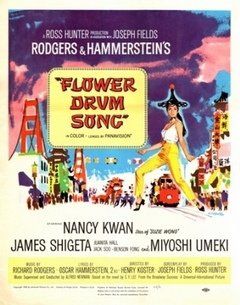
Flower Drum Song

Flower Drum Song is about a Chinese immigrant named Mei Li (Miyoshi Umeki) and her father who come to San Francisco illegally (by boat, nonetheless) as part of an arranged marriage to nightclub owner Sammy Fong (Jack Soo), who is completely and utterly Americanized and in love with a dancer at his club to boot. He wants to marry his dancer girlfriend, Linda Low (Nancy Kwan), who is mad at him for having an arranged marriage with Mei Li. Sammy decides to take Mei Li to Master Wang's (Benson Fong) house because he is much more traditional and he too has a son, Wang Ta (James Shigeta) who is of marrying age. Master Wang and his sister-in-law (Juanita Hall) instantly approve of Mei Li and want Wang Ta and Mei Li to be married. However, the sister-in-law, Madame Liang, wants Mei Li and Wang Ta to fall in love naturally - the "American way." Unfortunately, Wan Ta has noticed Linda Low and he decides to ask her out on a date, and she accepts. He gets back late from a date one night and runs into Mei Li, who instantly falls in love with him, but not he with her. Linda decides to use Wang Ta as a way to make Sammy jealous, and when Wang Ta proposes to her, she accepts and comes to his graduation from school party. Then Master Wong finds out and he is not so happy! He and Wan Ta have a fight and Sammy sees it as an opportunity to get Wan Ta to fall out of love with Linda. He then arranges for Master Wang, Wang Ta, Mei Li, and Mei Li's father to see Linda's nightclub act (!!!!) They are all shocked at her performance, and Wang Ta runs away and gets very drunk and ends up being found by Helen (Reiko Sato), a childhood friend of Wang Ta's who carries a torch for him. She takes him back to her apartment where he passes out and she sings about how much she loves him and has a big fancy dance number. The next morning, Mei Li drops off an item of clothing at Helen's house that Master Wang needs to be fixed, and she spots Wang Ta's shoes by the door. Assuming the worst, she flees and gets really sad. Wang Ta awakens and realizes his true feelings for Mei Li, and leaves Helen in the dust. We never see her again. Wang Ta finds Mei Li and tells her of his love, which she rejects. She and her father then pursue the marriage contract between her and Sammy. Unfortunately, Sammy has already proposed to Linda who accepted his proposal (for real), but there isn't anything they can do about it. Sammy tries to persuade Mei Li to not marry him, and it makes Mei Li realize that she is still in love with Wang Ta. She and Wang Ta meet before the wedding day and try to come up with a plan to get rid of the marriage contract. During the wedding ceremony, Mei Li announces that because she is an illegal immigrant, the marriage contract is null and she and Sammy cannot get married. The wedding then becomes a double wedding, with Wang Ta and Mei Li getting married and Linda and Sammy getting married too. 
Flower Drum Song was the first Hollywood film that featured an all Asian/Asian-American cast. They casted great actors, all of whom melded into their roles commendably. For this it gets props. However, I just can't get around how incredibly bad this movie is... The unfeasible plot. The perpetuation of the stereotype of a butterfly by Miyoshi Umeki. Nancy Kwan's reprisal of her "whore" role as Linda Low. The representations of the elderly people from "the old country" who can't wrap their heads around their more American offspring. It's all just so... painful.
Rodgers and Hammerstein. A phenomenal duo, right? After all, they did Sound of Music, Oklahoma!, South Pacific... But this was just bad. Bad music, bad plot, worse lyrics, worse-er dance numbers. Everyone talks about how Flower Drum Song was this fantastic musical for Asian-Americans because it showed us (yes, us) in a positive light. It did do that. I commend this film for that. But that doesn't hide the fact that this was a crappy crappy film. 
Look how slanty they drew Miyoshi Umeki's eyes! Blasphemy!
The characters in Flower Drum Song are also strange stereotypes. Sammy Fong is the gambling, Americanized, smooth-talking Asian playboy. Wang Ta is the studious, kind son who rebells a little by dating a nightclub performer but ends up marrying the immigrant girl. Mei Li is the quiet, subservient butterfly who only wants to get married and be happy in the United States. Linda Low is manipulative of her boyfriend(s) and enjoys being an Americanized girl. Madame Liang is proud to be Chinese AND a citizen of the United States, where "all are entitled to life, liberty, and the pursuit of happy times." Master Wang is the stereotypical grumpy old man who misses the traditional life back in "the old country" and wishes his children did too. Mei Li's father is just like Master Wang except that he is new to America and doesn't really "get" American ways. Helen is sad. These characters are odd. Sometimes they perpetuate old stereotypes that they were trying to get away from, and sometimes they break away from those and throw a curveball into our notions of what is Asian and Asian American. Unfortunately, the bad outweighs the good...


Oh Flower Drum Song, how do I dislike thee? Let me count the ways.

Let's begin with this song, shall we? Doesn't the title A Hundred Million Miracles scream "awkward!" to you? Maybe just a little bit? The very dissonant chorus of "A hun-dred mill-ion mir-a-cles! (Drummy drummy drum beat)" does not inspire feelings of wonder or happiness or make me want to sing along. The lyrics too are just... bad.
My father says that children keep growing,
Rivers keep flowing too.
My father says he doesn't know why,
But somehow or other they do.
They do! some how or other they do.

A hundred million miracles,
A hundred million miracles are happ'ning ev'ry day,
And those who say they don't agree
Are those who do not hear or see.
A hundred million miracles,
A hundred million miracles are happ'ning ev'ry day,

Miracle of changing weather:
When a dark blue curtain is pinned by the stars,
Pinned by the stars to the sky,
Ev'ry flow'r and tree is a treat to see,
The air is very clean and dry.

Then a wind comes blowing the pins all away,
Night is confused and upset!
The sky falls down like a clumsy clown,
The flowers and the trees get wet - Very wet!
Cringe. Make it stop. (And then there's a reprise later... Ack) You really have to listen to the melody and read the lyrics to really absorb all of the badness and destruction and bad goosebumps that this song dishes out. But that's not all! Miyoshi Umeki's accent makes it all the more painful. There's (thankfully) no switching of the "r"s and "l"s here, but it still sounds incredibly foreign. It doesn't translate well at all. (Fun Fact: Umeki actually went on after this movie to the TV show The Courtship of Eddie's Father - kind of a step down from a Rodgers and Hammerstein musical, huh?) It's phrases like, "ev'ry flow'r and tree is a treat to see... very clean and dry... night is confused and upset... clumsy clown... get wet - VERY wet!" that make my tummy twist in pain. 


And Suzie Wong enjoys being a girl. Aside from conveniently leaving out that certain time of the month, she seems very happy with her girlhood... Linda Low is not a whore... but you see the correlation? Both fluttery, girlish characters who enchant every guy who walks by (Yeah, yeah, yeah, both are played by Nancy Kwan, but that's not the point).
I'm a girl, and by me that's only great!
I am proud that my silhouette is curvy,
That I walk with a sweet and girlish gait
With my hips kind of swivelly and swervy.

I adore being dressed in something frilly
When my date comes to get me at my place.
Out I go with my Joe or John or Billy,
Like a filly who is ready for the race!

When I have a brand new hairdo
With my eyelashes all in curl,
I float as the clouds on air do,
I enjoy being a girl!

When men say I'm cute and funny
And my teeth aren't teeth, but pearl,
I just lap it up like honey
I enjoy being a girl!

I flip when a fellow sends me flowers,
I drool over dresses made of lace,
I talk on the telephone for hours
With a pound and a half of cream upon my face!

When men say I'm sweet as candy
As around in a dance we whirl,
It goes to my head like brandy,
I enjoy being a girl!

When someone with eyes that smoulder
Says he loves ev'ry silken curl
That falls on my iv'ry shoulder,
I enjoy being a girl!

When I hear the compliment'ry whistle
That greets my bikini by the sea,
I turn and I glower and I bristle,
But I happy to know the whistle's meant for me!

I'm strictly a female female
And my future I hope will be
In the home of a brave and free male
Who'll enjoy being a guy having a girl like me!
Her emphasis on the word "hairdo" cracks me up every single time. And I guess I'll admit it, this is a catchy, bouncy, silly song and I found myself humming it the other day while doing homework. Alright, big confession: this song is fun to sing. But it is also really bad, both lyrically and musically. Rhyming "hairdo" with "air do?" "Great" and "gait?" "Female" and "free male?" Breaking some new ground there, I would have never thought of that... See what I mean by stupid lyrics? Now because this was an all Asian/Asian-American cast, does this say anything about Asian women? Or just Asian-American women? Because Mei Li isn't prancing around in her room with her three reflections trying on clothes for her - she pretty much wears the same clothes the whole movie. Linda Low enjoys being a girl, but not the good, sweet, quiet Chinese girl. She is the bold American girl - and comes off as a whore in comparison to Mei Li. She's not quite as bad as Suzie Wong, but she's pretty close. "Out [she goes] with her Joe or John or Billy." Not to mention Sammy and Wang Ta, she goes out with Joe, John, or Billy! Does this imply that Asian-American girls are, uh, shall we say, more free-wheelin' than Asian girls from "the old country?" Maybe not free-wheeling, but more desirable? After all, Wang Ta falls for Linda Low first, and when he sees her nightclub act, he sees how "loose" she really is, and begins to recognize his true feeling for the more virginal Mei Li. Here it's the classic "virgin vs. whore" case - something that may become a trend in later films. 


Chop Suey. Juanita Hall was African-American. Not Asian. And yet she played the role of Bloody Mary, a Tonkinese woman, in another Rodger's and Hammerstein musical, South Pacific. So was this really an all Asian cast? Apparently not! Out, cur!
Chop suey, chop suey! 
Living here is very much like chop suey.
Hula hoops and nuclear war,
Doctor Salk and Zsa Zsa Gabor,
Bobby Darin, Sandra Dee, and Dewey,
Chop suey, --Chop suey!--

Stars are drifting overhead,
Birds and worms have gone to bed.
Men work late in laboratories,
Others read detective stories.

Some are roaming 'round the country,
Others sit beneath just one tree.
Tonight on TV's Late, Late Show
You can look at Clara Bow! --Who?--

Chop suey, chop suey!
Good and bad, intelligent, mad, and screwy.
Violins and trumpets and drums,
Take it all the way that it comes,
Sad and funny, sour and honey dewy,
Chop suey!

Ballpoint pens and filter tips,
Lipsticks and potato chips.
In the dampest kind of heat wave
You can give your hair a neat wave.

Hear that lovely La Paloma,
Lullaby by Perry Como.
Dreaming in my Maid'nform bra,
Dreamed I danced the Cha-Cha-Cha.

Chop suey, chop suey!
Mixed with all the hokum and bally hooey.
Something real and glowing grand.
Sheds a light all over the land.

Boston, Austin, Wichita, and St. Louey,
Chop suey.
Chop suey, chop suey!

And nowhere do they mention Chinese/Asian culture. It's all American. Zsa Zsa Gabor? Perry Como? "Lipsticks and potato chips?" Not so mixed up. Assimilation, much? Conformity, much? May we agree that this too is a painful and ugly song? CHOP SUEEEEEYYYYYYYYYYYYYY!!!!!!!!! Gross! Ew! It's obnoxious and stupid - what kind of message to it send to viewers? Don't listen to those Asian people, they sing about chop suey! Not only that... these lyrical geniuses named Rodgers and Hammerstein... rhyming "suey" and "suey" with "St. Louey" and "screwy" and "dewy" and "hooey." I am blown away. And then that dance number? Awkward hoedown with a Cantonese square-dancer caller dude? Funky funky waltz? That jazzy awkward tap dance? Those radical "rock and roll" moves? And then it ends with the couples bowing at each other with their little prayer hands and the gong noise? Who choreographed this? That was awkward and ugly! It's painful until you get to Patrick Adiarte's sooper cool solo bit near the end. And what being implied here? It shows that Asian people look really strange and awkward when trying to dance American-style. It shows that we cannot assimilate! Perpetual foreigners! Blasphemy! We can dance fine if we choose to! We can dance. We can sing. Don't you take that away from us - it's all there in Flower Drum Song. Just don't watch us, because it'll be, you know, awkward.


Remember that girl Helen? The one who gets dumped by Wang Ta? She gets to sing too. And then has a big dance number. Fancy, huh? This song is just really boring, so I'll save you the trouble of reading the lyrics. It's the dance number that gets me. Reiko Sato was a classically trained dancer, so there's no complaints in terms of her technique - but the part where James Shigeta transforms into the Monkey King... And they dance and dance-fight and then there's clones of him... It's a whole two minutes and thirty seconds of confusion. It's obviously choreographed in a Western style (much more successfully so than in Chop Suey) that works... but the Monkey King masks? The pseudo-bonsai tree? The cellophane fluttering in the background? It's all kinds of bad. It's awkward. It's a rip-off of Cyd Charisse and Gene Kelly's pas de deux in Singing in the Rain. 


I am not denying in any way that this film was monumental in it's casting choices and presenting Asians and Asian Americans as normal people, with only one non-Asian actor. However, it still showed us as awkward assimilators - perpetual foreigners. And it was just a crappy musical. 


Watch it here!

Friday, October 22, 2010

Collagin' #7

Progress is a really cool thing
Progress is a really great thing
So get off your butt let's make some progress
Progress Progress PROOOOOGRESSSSS
Gluestick!

Yes, I put googly eyes on Charlie Chan


Coming Soon!
Flower Drum Song
Charlie Chan Pt. 2
Enter the Dragon

Wednesday, October 20, 2010

The World of Suzie Wong

Freakishly enough, there's a reggae song by Jacob Miller references Suzie Wong... And I thought this whole thing was painful enough already...

You can watch the movie online too

Robert Lomax (William Holden) is going to Hong Kong to start a career as a painter after dropping his architecture job for reasons unknown. He hops on the ferry boat taking him to Hong Kong and he meets a girl who calls herself Mee-Ling (that's how it was spelled in the subtitles!) who accuses him of trying to steal her purse and doesn't want to talk to him. He proves her wrong and they begin to talk. Mee-Ling tells Robert that her father is very rich and that she is very proper and a virgin to boot. That's why she she didn't want to talk to him. Robert is obviously very taken with the girl but the boat hits shore and everyone departs. Robert heads off to a cheap hotel where he decides to rent a room for a whole month. Then he goes on down to the hotel bar where he sees... gasp... bar girls in qipaos cha-cha-ing it up with sailor boys. And the real nature of the hotel is exposed. Robert sits at the bar and sees Mee-Ling across the way with a sailor boy! He approaches her, calls her by her name, and she doesn't recognize him! She tells him that her name is Suzie Wong (Nancy Kwan) and she admits to being a prostitute. The next day, Robert goes to the bank and sets up an account there. He makes friends with the banker and the banker's daughter falls in love with Robert. That night he asks Suzie to come to his room - but not for screwing! Robert wants Suzie to pose for him! They eventually becomes friends and Robert learns that Suzie was forced into being a prostitute after her evil uncle threw her out of his house when she was 8. She never even learned to read or write! Suzie begins to fall in love with Robert and so does he, but he can't get past the fact that she's a prostitute. She keeps on seeing other clients and he keeps on painting her. One night, Robert goes to a dinner party with the banker and the banker's daughter. However, one of Suzie's clients, Ben, is at the party too with his wife. The two men immediately recognize her and the banker's daughter keeps on hitting on Robert. A few days later, Ben comes to Robert and tells him that he's leaving his wife for Suzie, which Suzie accepts to make Robert jealous. A few more days later, Ben tells Robert that he actually wants to break off his relationship with Suzie, but he doesn't want to tell her himself, so he makes Robert do it. Robert tells Suzie and she is so hurt that he confesses his love to her, and they begin a happy relationship. However, Suzie disappears for several hours every day, and Robert, becoming suspicious, decides to follow her. He finds her in a small shack outside of the city with a baby boy and a nurse. Suzie tells him that this is her son and this is where she has been going every day. She asks him whether or not he will love the child, and Robert promises to. This makes them even more happy. Unfortunately, Robert's paintings of Suzie haven't been selling very well, and this inspires the banker's daughter to try to help out Robert financially. Suzie offers to go back to prostitution so that she can make money and Robert can keep painting; however, Robert's pride prevents him from accepting either offer. When he finds out Suzie paid his rent for him using her own money, he throws a fit and tells her to go away. He realizes his mistake when Suzie doesn't come back and it begins to rain, so he asks his banker and the banker's daughter to help. Unfortunately, the jealous banker's daughter refuses to help, thinking that if Suzie cannot be found, Robert will fall in love with the banker's daughter. Robert has a big uh-oh moment and runs away to find Suzie. But alas! There's a giant rainstorm and the city might flood, so nobody is allowed to go to the outskirts of the town. Robert runs around until he finds Suzie, who is worried about her son. They run to Suzie's old house, where they find that the baby died in the flood. The last scene is a small funeral for the baby boy with Robert, Suzie, and Suzie's prostitute friends. At the end of the scene, Robert and Suzie decide to live the rest of their days together forever and ever. 
Dear Suzie. Dear Suzie Wong. She's so complicated, for goodness' sake! Suzie Wong is not a dragon lady. She does not desire to kill anybody or poison them or seduce them so they will give her information about stuff. Suzie Wong is (kindof) a butterfly. She is demure, sweet, and swears her subservience to her dear "Lobert Romax." Good grief make it stop. But at the same time, she is outspoken and brave, able to take care of herself and her baby boy - not really a butterfly characteristic. Sure, she's dependent on her man and she loves him unconditionally and promises to do whatever he tells her, but... Does this mean that Suzie is the "happy medium" between the two stereotypes? No. Suzie Wong is a Suzie Wong. She is the whore, the Asian "hooker with a heart of gold." But does this make Suzie Wong merely an extension of a non-race-specific stereotype? And while this stereotype of an Asian whore falling in love with a white guy does not appear in the media as often as Fu Manchu or Charlie Chan did, the connotations continue to exist today. Her image (in addition to the stereotypes the 1957 film Sayonara put out) set up the ideas that  "Oriental" women are better at sex, that they are subservient and adoring of their white men... all that jazz. But do we ever see her again? No, we merely see Suzie's legacy and the stereotype she enhanced now. Does this mean that Suzie Wong is dead? The next semi-close-to Suzie Wong character (yes, we'll exclude Linda Low from Flower Drum Song for now) that we see is the Vietnamese prostitute at the end of Stanley Kubrick's Full Metal Jacket. And that is not the same portrayal as Suzie Wong. That is sick desperation - a representation of the cynicism that begins to pop up in American cinema a few years earlier. Is the reason we don't see another Suzie Wong stereotype because there wasn't time for her to be reproduced? Did a change in what audiences wanted to see affect the longevity of a character like this? Granted, mentioning Suzie Wong to almost anyone who is Asian-American will result in any combination of the following: cringing, rolling of the eyes, a blog-worthy verbal rant, or an upwelling of emotion. But I digress. Is it because of the end of the Hollywood musical that we see no more Suzie Wongs?


Suzie does the cha-cha. How alluring. (That's really not helping my case...) Watch carefully and you'll see the other bar girls demonstrating their proficiency in the cha-cha as well.
 

This was not the first movie to feature a white guy + Asian girl couple. I won't even go into the widespreadness of that trend. It's responsible for me and lots of other kiddos. See how this leaves out Asian men + white women, let alone Asian men + Asian women? You won't see that as often as you will a white male and an Asian female. The white men want a pretty, demure, exotic Asian woman to take care of him forever and ever. The Asian women want a good-looking manly man, and historically, Asian men have not been portrayed as manly men (Yes, yes, Bitter Tea of General Yen). However, why do you suppose "Lobert Romax" and Suzie are together? Well, duh, it's for love. But to what extent? Why was Robert initially attracted to Suzie? Homeboy's got some yellow fever, huh? What was Robert attracted to? Was he attracted to the notion of having a sweet "Oriental" girl (read: whore) as his "permanent girlfriend?" Or was he genuinely attracted to Suzie's face? And here's the catch! Robert did not come to Hong Kong looking for a hooker. At first, he did not want to sleep with her - just paint her and her "Oriental" face (Oriental my foot. Nancy Kwan is hapa!). And this could be his "redeeming" quality, if you will. He doesn't just want the Oriental girl for sex! He really loves her! He abstains from sex out of love, while she's gallivanting around with sailor boys even though she really does love him too... And this is what makes the relationship between a white male and the Asian hooker. The purity of it all. (Oh irony.) 
I have a feeling that while there may not be a lot for me to expound upon here in this post, remnants of this performance and the connotations that the character of Suzie Wong has will continue to pop up here and there in future posts. The stereotype may not have persisted, but aspects of it sure have...

Alas! There was no yellowface in this film! It was replaced with the forbidden love between a "Wan Chai streetgirl" and the white artist dude. Forbidden love! But they are so in love! She promises to love him until he says to her, "Suzie, go away!" (Real line from the film...) So no yellowface... have we moved beyond it? Oh no. But this is a step in the right direction. A step towards letting Asian people play Asian people. But at what price? Sadly, the step in the right direction is canceled out by the lasting impression Suzie made on America. And here is where I do a shameless plug and tell you to stay tuned for next time, where I'll rant about Flower Drum Song!

Sunday, October 17, 2010

Yellow: Race in America Beyond Black and White by Frank H. Wu

 
It's a little concerning how long it took me to read this book. Warning: This is not a book you can read with your mind on your dinner.

Despite the fact that this book is not so easy to read, I thoroughly enjoyed this book. Wu's description of anti-Asian sentiments in America is compelling and interesting, going pretty in-depth into the origins of these stereotypes, and then gently bashing them to pieces. I particularly enjoyed his sections on "The Perpetual Foreigner" and the model minority. Wu also tackles affirmative action, immigration, assimilation and intermarriage. One particular phenomenal chapter was about the "Dilemma of Diversity." Wu raised a lot of points that I found were really interesting and I had not thought of them before. I found that the examples and occasional anecdotes he wrote about I could relate to in some small way. Overall, this book opened up a whole new view on being Asian in America and what that means.

The subtitle of the book is "Race in America Beyond Black and White." Wu definitely goes into the contrasting of white and African American culture with a lot of really interesting analysis; however, I think I would have liked to have seen more contrast between white and Asian American perspectives or between African American and Asian American perspectives. That and the incredible denseness of this book...

A great read overall.

Friday, October 15, 2010

Charlie Chan in Shanghai Pt. 1


Charlie Chan in Shanghai (1935) begins with the venerable Mr. Chan (Warner Oland) arriving in Shanghai to help arrest a opium-smuggling gang (how predictable... China... opium... Shanghai....) for the US government. He then receives a letter (anonymously) telling him to not get off the boat at Shanghai. However, he does. He gets off the boat and is met by his Number One Son (Keye Luke) and the happy couple Philip Nash and Diana Woodland. They then go to a welcoming banquet for Mr. Chan, hosted by Diana's uncle. Diana's uncle is opening a box with a present for Mr. Chan when BANG! The opening box pulls the trigger of a gun concealed inside, and Diana's uncle is dead. Then Mr. Chan begins to investigate the case and discovers that Philip Nash had the box in his possession all day and never bothered checking it to see if it had anything inside. That night, someone tries to assassinate Mr. Chan, but they are unsuccessful, as they shot a dummy that Mr. Chan had set up. The next morning, Mr. Chan calls for room service, and a telephone operator (who is in cahoots with the leader of the opium ring) connects him (secretly) to the opium leader so that he hears that Chan is still alive. Then Chan leaves with a chauffeur who kidnaps him! Number One Son figures out what happened and calls for a taxi to follow the car that Chan left in, but Number One Son's chauffeur is in cahoots with the other kidnapper as well! Then they are both taken to the house of Ivan Marloff (a Russian... my goodness), where he begins to interrogate them - but wait! Chan tricks the evil dudes into thinking that the police followed the two cars to the house, and Number One Son and Chan escape! Chan discusses Diana's uncle with James Andrews - another American agent who is inspecting the opium-smuggling gang. But then - somebody tries to assassinate Chan, and this time Andrews as well! They find the gun and see that it has Philip Nash's fingerprint on it, and he is arrested. Chan finds a letter in Andrew's belongings with an apparently unimportant message on it - but when the letter is heated, it reveals a secret message! Andrews and Chan are shocked at this conclusion, so they decide to go back to the house of Chan and Number One Son's kidnapping and look for clues. Diana Woodland remains convinced that Nash is innocent, so she has a meeting with him and she sneaks him a gun, and they escape. Chan then receives a tip-off from Andrew's valet that the opium gang is meeting at the Versailles Bar, where Nash has already met up with Ivan Marloff, and he demands that he be brought on their illegal ship as well. Marloff sees that Nash is a spy for Chan and knocks him out. Chan and Andrews are about to go down to the secret dock where Marloff and his men are when the police show up and have a shootout! Once the opium-smuggling gang is arrested, Chan reveals that it was Andrew's valet who tried to shoot Chan through the door, and he put Nash's fingerprint on the gun using a stamp pad. Andrews then offers to take the gang to the police station when Chan reveals that Andrews was the real leader of the opium gang, and that the real Agent Andrews was murdered three weeks previously. The valet and pseudo-Andrews go to jail while Nash is declared innocent.
In the beginning of the film, there is a song that Charlie Chan sings to a little, silent, flower-holding Chinese girl (well, she's a little Asian girl) about a princess named "Ming Lo Fu" whose father was The Emperor "Fu Manchu." 


Long the journey on the way, but his heart was gay, 
For was he not the Prince both strong and brave, 
But the Princess fair to save. 
And he slew the mighty dragon, even cut off his seven heads, 
And in his cave he found the Princess bound to her lowly bed. 
 Then came they both back to the land of the mighty Emperor Fu Manchu, 
To claim his reward, the dainty hand of lovely Ming Lo Fu.


Ugh. Ew. Gross. What kind of name is "Ming Lo Fu," let alone "Fu Manchu?" That's pretty much the equivalent of the name John Chinaman or Ah Sin - in other words, it is horrendous. What's really interesting is that the Fu Manchu in the song is portrayed as an almost positive character, whereas previously in film history the caricature of Fu Manchu was General Yen in the dreamy-almost-rape scene times a billion. The song says that the Emperor was mighty and the Prince was strong and brave - those are good stereotypes for the emasculated and desexualized Asian men in this era (and many after) of film? Right? Why seven heads? Why would anyone Chinese want to kill a dragon? Dragons brought good luck... and rain... and that made crops grow... Seriously, what Chinese would kill a dragon? This lack of research in these screenplays is making me awfully tired. It was so trendy to just make things up about other cultures, huh? Did anyone ever think about how maybe it was a bit insensitive? Obviously, the people behind The Good Earth tried... not very hard, but the effort was there - right? What really sucks is I cannot find a video clip of Oland actually singing the song in the movie - so you'll just have to insert the most generically "Oriental" tune with those words. Good luck. 

Oh Warner Oland. You started with a portrayal of Fu Manchu. What made you switch from the terrifying and power-hungry "Son of Satan" to the humble, kiss-ass,  Apparently you did not do much in order to portray China’s most venerable detective. You had a couple of drinks to slur your speech (the nerve!) and grew out your goatee, brushed your eyebrows up and your mustache down... Does that make one "Oriental?" Gracious me, I don't think so. You are still clearly white, despite your supposed "Mongol ethnicity through your Russian grandmother." And what's this hooey about Asian people mistaking you for one of their own? Jeebus, you had me fooled, that's for sure!  

Number One Son. Number One Son. I don't think that he was ever referred to as "Lee" throughout the entire movie. Keye Luke was 31 when he made this film, and he plays a character that is written for a 16-year-old. There's something weird about hearing a 31-year-old saying "Gee Pop!" Or is it just me? This isn't really emasculation, as Number One Son is wasting money trying to convince his girlfriend that he can't take her out because he's busy throughout the entire movie. However, it's definitely putting Luke's character on a lower level by making him seem more earnest, less mature and calculating as his dad is - and he doesn't even get to be called by his name. Is this racism? Or is it just an attempt by the screenwriters to make Charlie Chan a more important character, putting more of the focus on him? Why can't Number One Son be smart and solve mysteries too?


Honestly, I think I might like Charlie Chan better if he kept his mouth shut. Stop spewing useless proverbs, old man! “Motive like end of string, tied in many knots. End may be in sight but hard to unravel.” Who says stuff like that? My grandmother doesn't even spew proverbs like that. Who wrote this crap? Honestly? (Upcoming: A post all about Chan-isms!)


And you know what else I'm sick of? Opium! Opium dens, opium smugglers... True, the stuff has only made its appearance in two of my posts so far... but geez! Rudyard Kipling ("Gate of A Hundred Sorrows"), Jules Verne ("Around the World in 80 Days"), Agatha Christie (Hercule Poirot in "The Lost Mine"), Hergé (Tintin in "The Blue Lotus"), and countless other books (not to mention films) show characters of all types going into Chinese-run opium dens. And while I am not denying that opium dens were often run by Chinese people, I hate seeing these "dens of sin" constantly being associated with my people! Hell, even the Wizard of Oz had a reference to opium and sleepy poppies... although that wasn't directly tied to Asian people at all... Does it still have that connotation? Yes the opium smugglers in Charlie Chan in Shanghai are working with a Russian guy, but they are smuggling out of Shanghai - that's not much of an improvement, to be honest. 


And if you were wondering about the creepy dragon lady on the movie poster - she makes a two minute appearance as a Yellowfaced Chinese Bellydancer. Completely irrelevant to the story. A waste of poster space. This is (yet again) an example of exoticising China and Chinese women - oh, excuse me, Oriental women...


I rented Charlie Chan in Shanghai because I thought it would offer the most racist bits in any of the Charlie Chan films - but now I wish I had gone with Charlie Chan in London or Paris, because that would have put this (regrettably) iconic character in an all-white setting and seeing the racial tensions play out would have yielded many more freaky observations and the like. I can happily say that this movie was short, and because it was a silly mystery, I didn't have to think about the crazy plot and all. I could focus nicely on Oland's portrayal of this unforgettable member of the Awful-Stereotypes-That-Annoy-The-Crap-Out-Me Hall of Fame. 

Wednesday, October 13, 2010

Collagin' #5

Progress!
Just terrifying


Coming soon! 
Charlie Chan in Shanghai
The World of Suzie Wong
Flower Drum Song

Sunday, October 10, 2010

The Bitter Tea of General Yen

Their Forbidden Love Wrecked an Empire!


Well, it really only wrecked a province... 


Doesn't the poster just terrify you? Yes, yes it does. It strikes fear in my heart.  


I was so bewildered by this movie. Everything about it screams... Well, I don't know what it screams, to be honest. It has the ability to leave one completely speechless (which is why I type these things). 


"Human life is the cheapest thing in China... Don't be fooled by [the Chinese] looking civilized, they're all treacherous and immoral." (An actual line said in the film) Now if that's not enough to make you run for the hills, I don't know what is.


The film (based on the novel by Grace Zaring Stone) begins in China, during the Chinese Revolution. A white missionary girl, Megan Davis (played by Barbara Stanwyck) comes to China (Shanghai, not surprisingly) to marry her childhood sweetheart (played by Gavin Gordon) who is also a missionary. It is the night before their wedding when Megan's fiancé decides to delay the wedding to go rescue some orphans. Megan decides to go along. However, they need a pass from the "Oriental bandit" General Yen (portrayed in yellowface by Swedish Nils Asther) in order to reach the orphanage and rescue the kiddies. General Yen finds out that Megan's fiancé "prefers civil war to the arms of his loving bride." (More on this later...) This earns the fiancé quite a bit of ridicule at a check-in point along the road. They eventually get to a train station and prepare to send the kids off to safety. The fiancé gets into a rickshaw and goes off, but some dude clubs Megan Davis in the back of the head and she is kidnapped (oh my!) by General Yen, who takes her back to his "Summer Palace" via train. She also meets his concubine Mah-Li (Toshia Mori), his American financial advisor, Mr. Jones (Walter Connolly), and his Captain (Richard Loo). Initially, she wants to go home and doesn't fully comprehend what a monster Yen really is, until, of course, she wakes up one morning to the sounds of a firing squad outside her window. She then begs to go home but alas! Yen does not permit that, so he requests her presence at dinner, which she refuses three times. Then she goes out for a smoke on her patio and dreams about a slanty-eyed, long-fingernailed, drolling, bucktoothed, Fu Manchu-ed mustachioed Chinaman who is about to rape her when ta-da! General Yen saves the day and they kiss (Controversy controversy controversy!) Then she wakes up to see Yen standing before her, and they discuss the differences between American and Chinese culture (whoa). After Yen leaves, Megan sees that Yen's concubine, Mah-Li, is secretly in love with his Captain. Megan agrees to keep it a secret and the two become friends. She also finds out that Mah-Li has been acting as an informant to the rebels and for this, Yen sentences her to death. Megan then pleads for forgiveness and gives Yen a big speech on kindness and being a loving human being - which Yen soon pronounces as mumbo-jumbo. Then he offers to spare Mah-Li's life if Megan will remain his hostage. The Mah-Li betrays Yen to the rebels (again) and his army and servants all abandon his summer palace. Upon realizing this, he prepares to drink poisoned tea until Megan comes to his room, having realized that she is infatuated with him. She tells him of her devotion and breaks down crying. Then Yen drinks his poisoned tea and dies. The next scene is Yen's financial advisor Mr. Jones and Megan riding in a train car back to Shanghai, where, presumably, Megan will return to her fiancé. And credits roll. 


Historical Context: The Hays Code regarding film censorship had not been passed yet, so this type of movie was perfectly legal; however, upon release, nobody went to see it because interracial love was too unbearable a thought. Despite the fact that it debuted at Radio City Music Hall (and being the first film to do so), it still didn't strike a positive chord with the American (or British) audiences. Babs Stanwyck herself said that "the women's clubs came out very strongly against it" (citation) and that this surprised her. Honey! The Chinese Exclusion Act wasn't even going to be repealed for another ten years - does that give you a little peek into the minds of the masses? If the Chinese weren't allowed to be citizens, don't you think they also wouldn't be allowed to fall in love with whites? Naïvete, much?


Eeeek!
 The most interesting and controversial scene in the film is a dream sequence in which Megan dreams about an exaggerated caricature of General Yen (all long fingernails, bucktoothed, drooling, slant-eyed rapist) coming into her room and about to attack and conquer when huzzah! Megan is saved by the general!  And then it ends in a kiss! A KISS! Holy crap! What's this supposed to insinuate? "Hey, Chinamen will rape you! But fear not, one type of Chinaman will save you from the rapist! Hurray!" What kind of mixed up message it that? First they issue a warning. Then they say that it's okay... What's very interesting is that it is a white woman falling in love (or lust, depending on how you look at it) with a Chinese man. Isn't it usually the other way around? Chinese/Asian girl and a white guy? Yeah, it usually is. But here, you have the opposite. Here, you have the sexier, scandalous-er version of Broken Blossoms. General Yen is the frighteningly masculine Asian male, who oozes testosterone and danger with every glare at the camera (You'll see a reprisal of this stereotype in Joy Luck Club... much much later). And it begs the question - is it better to perpetuate a stereotype of a potential-rapist-chauvinistic-scary "gangster" or an emasculated and unattractive "geek?" (True, we see the "geek" stereotype appear much later - around the same time we see the "model minority" appear, but the "geek" stereotype seems to have roots all the way back in Broken Blossoms...) Which is better for Asian men? Well, obviously, neither. 

Then you take the role of Mah-Li, played by Toshia Mori (who is Japanese, not Chinese). Initially, the role was supposed to go to Anna May Wong (no surprises there) She plays the role of a butterfly/lotus blossom but she's really a dragon lady in disguise! Pretending to be all subservient one moment and then plotting to overthrow Yen the next? You could very stupidly yell "girl power!" right here, but a more appropriate phrase might be "Dragon Lady!" True, she's not pulling an Anna May Wong in "Shanghai Express," but hey! She's plotting and being stealthy and backstabbing Yen! She's dangerous - and she's sexy. She's a concubine, for crying out loud. Her role, thank goodness, is played by an actual Asian person - but does that make Mori's role into something good? A positive portrayal? I suppose we couldn't have asked for something better - it was 1933 after all. But there's something off about her character too. She's extremely quiet, demure, and subservient to everyone in the household. She's persistent and conniving, passing information to rebel sources. She abandons Megan after Megan saves her life and convinces Yen to cancel her execution. She's in cahoots with the rebels! While Mah-Li is at first portrayed to be the stereotypical butterfly, she soon becomes a semi-embodiment of the quote I listed waaay up at the top. She's treacherous. And this is bad. I had such hopes that she wasn't going to live up to that awful quote... And my dreams were shattered. So sad.


And the yellowface. You thought I'd forgotten, eh? Lies. I haven't. It's hard to forget a face like that. With that much makeup. How do I detest thee, O makeup on Nils Asther's face? Let me count the ways. The mustache. It's reminiscent of Fu Manchu's. It's giving me nightmares. Strike one. The slanted eyes. Oh, the slanted eyes. Looks like they've been taped pretty severely. And that's pretty self-explanatory. Strike two. The eyebrows. Apparently he shaved them off and then the makeup artists drew on new slanty ones. Strike three. And look at that expression! The dastardly, conniving evil man! Just looking at his face invites distrust! Do I need to elaborate how disgusting this trend is? Was? No! I need not! Just gaze at his face. This is a white guy. A Swede to be precise. A Swede playing an "Oriental," if you will. When did this become unacceptable? WHY was it acceptable? I'm just so confused... 


Overall, this was one of the weirder movies I have seen. I can't even begin to describe it. It's not even a very technically appealing film - the shots are bland, the music is full of zithers and gongs and who knows what else, the acting is sub-par... It's all kinds of bad.