Keep on Wondering...

What are the connections between social and historical forces and the representations we see?
Why is yellowface still acceptable? When and how did yellowface turn into whitewashing?
How do these representations create and/or perpetuate stereotypes that are present in our world? What is the impact?
Showing posts with label yellowface. Show all posts

Sunday, February 20, 2011

The Mask of Fu Manchu

I was supposed to watch this one three whole weeks ago... but because Netflix is stupid (kinda) I didn't get to see it until now. Better late than never, I suppose. 
The Mask of Fu Manchu is about a group of English archaeologists, commissioned by a certain Sir Nayland (Lewis Stone) who race against the power-hungry Dr. Fu Manchu (Boris Karloff) for the contents of Genghis Khan's tomb in the Gobi desert. But before the expedition can begin, the lead archaeologist, Sir Lionel Barton (Lawrence Grant) is kidnapped by one of Fu Manchu's henchmen and taken away to his palace, where Fu Manchu tortures him for the information about where the tomb is. He is kept there for many days until his daughter Sheila (Karen Morely) and her fiancĂ© Terry (Charles Starrett) begin to worry. They go to Sir Nayland and tell him that they will continue the expedition without fear of Fu Manchu and that they will try to find Sir Lionel anyways. Nayland lets them go, but soon accompanies them on the journey as well. The expedition team starts off and soon finds the tomb with no problems. There, they take the Mask and Sword of Genghis Khan to put in the museum, but Fu Manchu wants the Sword and Mask to "become" Genghis Khan and take over the world! They get the artifacts back to where they are staying for the night and set a guard to watch them just in case. The guard is killed in the middle of the night but the sword and mask aren't stolen. The next day, one of Fu Manchu's henchmen comes to the house where the team is staying and offers to trade Sir Lionel Barton for the sword and mask. Sheila jumps at the offer despite Terry's doubts, so Terry brings the sword and mask to Fu Manchu's palace, where he is looked over in strange ways by Fu Manchu's Dragon Lady-China Doll daughter Fah Lo See (Myrna Loy). Fu Manchu takes the sword and tries to do some freaky electrical stuff to it, demonstrating his scary powers. However, Nayland secretly swapped the real sword of Genghis Khan's for a fake, so Fu Manchu's special electricity experiment doesn't work. Terry is whipped as punishment under supervision of Fah Lo See, who later plans to make him her sex slave and then kill him. Fu Manchu steps in and injects Terry with a mind-control serum and sends him back to bring Sheila, Nayland, and the real sword and mask to Fu Manchu. He does so and they all walk right into the trap. Fu Manchu plans his world domination strategy and decides he needs a ceremony to celebrate it. He sends Sheila off to get ready to be sacrificed at his ceremony, who gets angry and says to him, "You yellow beast!" He sends Terry off to be bedded by Fah Lo See. He sends Nayland off to be eaten by some crocodiles. And he goes off to put on his fancy robe for the ceremony. Nayland then manages to escape and rescues Terry, while Fu Manchu assembles his army of Middle Easterners, black guys, and some other Asian-looking people for a pep rally where he wears the mask and wields his sword. Nayland and Terry find a big electronic death ray zapper and zap Fu Manchu as soon as he is about to stab Sheila. Then, for good measure, Nayland and Terry zap his followers as well. Fast forward several days, and Nayland, Sheila and Terry are aboard a boat back to England. They toss the sword over the side of the boat (but not the mask?) so that it will be safe from any future Fu Manchu.

Watch 6 - The Mask of Fu Manchu [1932].avi in Horror  |  View More Free Videos Online at Veoh.com
"Will we ever understand these Eastern races?" -Sir Nayland
Remember how I wrote about Flash Gordon and Ming the Merciless? He is Fu Manchu, just from outer space. 
The horror. Quite literally, I'm afraid. This movie is the embodiment of Yellow Peril. It's the Perpetually Foreign and Inherently Evil Scary "Oriental!" Because Dr. Fu Manchu wants to take over the world! He wants to lead all of Asia in an uprising against the accursed white race! He enjoys torturing people! He injects funky serums into the bloodstreams of next-to-naked white men! He wants to sacrifice a white woman to an accursed pagan god! The horror! The indignity! 

"Should Fu Manchu put that mask across his wicked eyes and take that scimitar into his bony, cruel hands, all Asia rises. He'll declare himself Genghis Khan come to life again. And that, my friend, is what you have got to prevent." - Sir Nayland
Some background on Fu Manchu: Originally conceived by British author Sax Rohmer, Fu Manchu was "yellow peril incarnate" an an evil scientist to boot. 
"Imagine a person, tall, lean and feline, high-shouldered, with a brow like Shakespeare and a face like Satan, a close-shaven skull, and long, magnetic eyes of the true cat-green. Invest him with all the cruel cunning of an entire Eastern race, accumulated in one giant intellect, with all the resources of science past and present, with all the resources, if you will, of a wealthy government--which, however, already has denied all knowledge of his existence. Imagine that awful being, and you have a mental picture of Dr. Fu-Manchu, the yellow peril incarnate in one man."
-- Nayland Smith to Dr. Petrie, 
The Insidious Dr. Fu Manchu, Chapter 2
Scared, huh? I know I am. He's everything scary and bad about Asians compiled into one dude with freaky long fingernails and some funky facial hair. In fact, this sounds like a Moriarty-type criminal mastermind trapped in Sherlock Holmes' body! Whoa! Strangely enough, the Fu Manchu books were sort of like Conan Doyle's Sherlock Holmes series, featuring Nayland Smith and Dr. Petrie versus the (apparently) insidious Fu Manchu. Except that Nayland Smith isn't brilliant, and neither is Dr. Petrie. They're just racist and often voice the anti-Asian sentiments of the book (and presumably Sax Rohmer as well). It's just Fu Manchu that's cunning and clever and supremely evil and anti-white. So not only do you fear his evildoings - you have to fear his intelligence as well! 
What does this remind you of? The model minority? This fear that China will take over the world? Yes and yes! He's super smart (model minorty) and he wants to take over the world (China takes over the world)! Captain Obvious, reporting for duty!


"Men of Asia! The skies are red with the thunderbolts of Genghis Khan! They rain down on the white race... and burn them!" - Fu Manchu 
Let's ignore Fu Manchu's scary intelligence for a moment, shall we? Let's focus on his sadistic scariness instead. He puts Nayland on a weird seesaw that gradually lowers him into a pit of (presumably) hungry alligators (or are they crocodiles?). He puts some other white guy on a platform between two walls of spikes that inch closer and closer together until... well, you get the idea (Said white guy is rescued, but not before he freaks out sufficiently). He has Terry whipped into a pain-induced stupor and then injects him with funky serum. He puts the good Sir Barton under a giant, endlessly clanging bell for days without food or water or reprieve from hearing the sonorous clanking, eventually driving poor Sir Barton insane. What does this do, you ask? This makes Fu Manchu an even more frightening character. Not only will he kidnap you, he'll torture you too! It's another little aspect to this already disgusting character that makes his foreignness and his evilness even more intolerable. He'll torture you in ways unimaginable! And he'll get a kick out of it! And on top of that... he's Asian! Asian and evil! Evilly Asian! Asianly evil! My eyeballs are rolling in terror!

Then there's Fu Manchu's army of Asians. Of course, this screams of perpetual foreigners and peril of all types - that's to be (hate to say it) expected from a movie from this time period. However, the only "East Asians" we see in the movie are Fu Manchu and his creepy little daughter, plus or minus a few mute extras. The rest of Fu Manchu's army is made up of... Middle Easterners? What's the subtext here? That the East Asians are the power-hungry ones, and the Middle Easterners are the ones who will follow their leaders like little woolly sheep? I have no ideas. Care to help me out on this one?
This one's right up there on the So-Racist-it-Makes-Me-Violently-Sick list with Mr. Moto. Shame.

Thursday, February 10, 2011

Dragon Seed

Another Pearl S. Buck novel made into a movie. Dear Lord. 

The story begins with Ling Tan (Walter Huston), the patriarch of his family consisting of his devoted and snarky wife (Aline MacMahon), his three sons Lao Ta, Lao Er, and Lao San (Robert BiceTurhan Bey, and Hurd Hatfield, respectively) and the wives of two of his sons, Jade (Katharine Hepburn) and Orchid Frances Rafferty). Lao Ta and Orchid have two children together, a baby girl and a toddler boy. Lao Er and Jade have no children because they don't know they're in love yet (and I haven't even gotten to the real plot yet). Ling Tan and his wife (credited as "Ling Tan's wife") try very hard to keep the "old ways" going in the house, while Jade, who is a sort of pseudo-femme fatale, tries to tell them about the new ways of the world. The movie takes place during the Second Sino-Japanese War (which, honestly, I know very little about). "Evil dwarfs" from Japan invade the village near Ling Tan's farm after invading other parts of China and bombing the land, and soon take over, raping all the women and killing all the sons and eating all the food and being evildoers. The whole family joins a resistance group and begins killing Japanese soldiers and burying them under their floors. Even Jade joins in, poisoning some food and knocking out an entire regiment of Japanese soldiers. Eventually the Japanese are too evil to hang around, so all of Ling Tan's family (or what is left of them) up and leave for the mountains. The End.
There really is no plot to this movie. I mean, there is... But the first 30-45 minutes is just Jade and Lao Er getting to know each other and planting rice and reading books together. The next hour and a half consists of alternate shots of the Japanese being evil and Ling Tan's family taking revenge. That's all there is to it. 

The similarities between this movie and The Good Earth are uncanny. Both have subservient yet strong women who are not particularly beautiful but make good wives and bear sons. Both have supportive husbands who are also not particularly beautiful and love the fact that they have sons. Both movies have a stock character who is lazy and fat and a kissass. Both movies (and novels too, I guess) glorify the hardworking Chinese peasant while dismissing the upper class and royalty. Both stage large scenes of full-scale riots complete with fire and shouting and running and the works. I was a little freaked out by all the similarities, to be honest. 
Now this is scary. I've seen some pretty horrific yellowface but it's mostly been on males. This takes the cake for Female Yellowface. Look at those eyes. That's just... gross. 
I have nothing against the character of Jade. Jade is strong-willed and independent - it's great! She's no Lotus Blossom or China Doll - nor is she a Dragon Lady. Of course, she has qualities of a Dragon Lady (poisoning soldiers, being smart) but she lacks the sex appeal that the stereotypical young Dragon Lady has. However, I dislike the way Katharine Hepburn portrayed her. There are two interpretations of her portrayal. One is that Hepburn played herself in yellowface. Vocally, this is very true. It sounds just like Katharine Hepburn being Katharine Hepburn. The other is that she took Luise Rainer's interpretation of O-Lan and made her more of an outspoken feminist but kept the same physical qualities. Both O-Lan and Jade employ coy tilts of the head to express their love for their homely husbands and seem to be meek and hesitant with their movements. 
The purpose of this film was to glorify and build sympathy to the Chinese and to make Americans hate the Japanese. It's quite easy to sympathize with the Chinese characters of the film - they are hardworking, loving, and peaceful, sacrificing themselves for their children and fighting back against the "Evil Dwarfs" that are the Japanese. They are also all portrayed by white people - not actual Asians. And the cameo of Benson Fong doesn't count - he plays a militant hater of the Japanese who takes his anger out on Ling Tan's merchant brother-in-law. However, the Chinese children in this movie are actually played by Asian children. And they are pretty darn cute - just their wide eyes and chubby cheeks elicit prolonged "Aaaawwww"s from the audience, I guarantee you. This makes it even easier for the American audience to sympathize and end up caring about the Chinese. Remember, this film was released during 1944, towards the end of WWII. China was, at the time, our ally, and Japan was America's enemy. The film then shows the Japanese as cunning, sly, evil men with large teeth and an insatiable appetite for women and wine - they're all Japanese Fu Manchus! A group of them attack, rape, and kill Orchid after she is caught by them trying to hide her children. Another group of them kill Ling Tan's mother in his courtyard. They steal all of Ling Tan's hard-earned crops and starve out the rest of the village. And on top of that, all of the Japanese soldiers were played by Asians. In this way, the Chinese take on the more sympathetic role, not just because of the fact that they have "good" qualities but because they were played by white people - and therefore, a bit more trustworthy. However, getting the Asians to play the bad guys was making the fear of the Japanese even more real and tangible - one didn't have to imagine that these were Asians/Japanese, because they were. It was a horribly clever idea to do this, and it probably resulted in American audiences hating the Japanese even more. Granted, the Japanese did do some pretty awful things while occupying China, but... come on! This is a little much!
Awwwww,
There's a scene where Katharine Hepburn is bathing her cute Asian baby and she sings a little song in a pentatonic key and it's about cherry blossoms and the river that flows... something strange and pseudo-Oriental like that. Reminded me of Suzie Wong's cloud song -only this time, the song was being sung in English. However, that did not detract from the messed-up-ed-ness of the song. Why is it so difficult to listen to these types of songs? Probably because they were composed by white people who have no idea of what a traditional Chinese song sounds like. These types of songs also seem to crop up more often in these old films from the "Golden" Age of Hollywood as opposed to now, with the exception of Jackie Chan's Chinese lullaby in The Spy Next Door.
Then there's the plethora of accents going on. Not one of them can be classified as "Oriental." Lao Er has a British accent, one character has a Russian accent (what?!), Ling Tan speaks with a standard American accent, and the Japanese just sound... like they're from Britain. It's weird. Very weird. 
There's also the issue of sexism in this movie. Most of the characters freely joke and toss around the ideas about beating women up and saying that their place is in the kitchen and nowhere else. The first scene with Katharine Hepburn in it shows her at a lecture in the village presented by some university students that are showing how evil the Japanese are. Lao Er shows up looking for Jade and sees her stand up and say to the students that she will help fight them. She says, "Yes! I will come!" And Lao Er shouts, "You come home! I'm hungry!" And everybody laughs. I'm not sure what the intent of this scene is supposed to be. Are we supposed to hate the Chinese for being sexist and keeping women subservient and in the home sphere? Or are we supposed to laugh as well, because a wife's duty to her husband includes making him dinner? Does the fact that their characters are Chinese change the sexism embedded in that exchange? I have no idea. 
Overall, this movie was exactly the same as The Good Earth - just more anti-Japanese, more specific about the time period it was set in, and more of a propaganda film. There was still gratuitous yellowface and fetishizing the humble Chinese. 

Saturday, February 5, 2011

Flash Gordon: The Emperor Ming and Other Offensive Stuff

I honestly don't know why I watched this miserable excuse for a movie. The worst thing I have ever had to sit through - and not just because of the twisted, odd little racist plot details.

The only good thing I can say about this pathetic bit of "filmmaking" is that Queen wrote that catchy, soaring theme song. Yes, that's dear old Freddie Mercury belting out that "FLASH!.... AAAAH!... Savior of the universe!"  
Did you see that Fu Manchu-esque evil space lord dictator guy? Yeah? That's Emperor Ming. MING! And not just any Ming - he's Ming the Merciless! He's an alien and his name is Ming. Translation: They're implying that the name "Ming" (a very stereotypical Asian name) is alien. Foreign. Different. And, judging by the context of the character, evil.
There's really no need to explain the plot, because there isn't one. Long story short: Flash Gordon (Sam J. Jones), the white-as-white-can-be, all-American football star, teams up with some other white aliens to take down the Oriental-esque Emperor Ming (Max von Sydow) from destroying Earth (never mind any other planets that might be in danger).

Ming the Merciless was originally conceived as Flash Gordon's nemesis in the comic strip of the same name in the year 1934. This was one year after Chang Apana, the inspiration for Charlie Chan, died, and a year after Filipinos were barred from immigrating to the US. An odd mix of pro-Asian and anti-Asian sentiments, don't you think? Yeah. And then came Emperor Ming the Merciless, a demonic, intimidating evildoer with a penchant for torture and for bedding white girls, not to mention a creepy (incest implied) relationship with his daughter Aura. Now, nowhere in the comic nor the movie (the 1980 version) is Ming the Merciless ever referred to as being of Asian descent or claiming some allegiance to an Asian country. However, the itty bitty hints and details surrounding his character have definitely been inspired by debilitating stereotypes surrounding Asian people. 

1. The name. I said it before. "Ming the Merciless." The "Ming" bit just screams "Asian!" The "Merciless" bit screams "EVIL ASIAN!" So all together, it screams, "Asian EVIL ASIAN!" And believe you me, it's not a pleasant sound.
2. The clothes. It's obvious that the clothes are not authentic Asian garments (well, specifically Chinese garments), but everyone's wearing flowing silky-looking robes that look extremely "Oriental!" Mr. Ming's harem girls are all wearing Chinese-style headdresses that look like they were made out of tinfoil. He's wearing plenty of tinfoil Chinese emperor robes himself. It's all so otherworldly, yet distinctly Asian. Again, fetishizing and making Asian-ness something unnatural and, no pun intended, alien. 
3. The facial hair. Classic Fu Manchu stuff. All that drawn-out beard and moustache? The arched and overgrown eyebrows? Coincidence? I think not!
4. The harem. The harem. The harem. Ming's harem. Ming's harem of white women. Ming's harem of white women who wear "Oriental" clothes. Just like Fu Manchu, Ming has an insatiable appetite, it seems, for white women, or just women in general. And this is no Charlie Chan or Mr. Moto. One needn't worry about the Honorable Detective or the Sly Secret Agent stealing and raping your women. But beware of Ming the Merciless, otherwise known as Fu Manchu! He'll seduce your women and add them to his collection of scantily clad alien whores!
5. The not-so-subtle reference to opium. When Flash's would-be girlfriend ends up in Ming Manchu's harem, she is offered a drink that will alter her mind and make her enjoy her (ahem) experience with Ming Manchu that night. She drinks it and is completely infatuated with the magical beverage. It's a little too reminiscent of opium for my taste. And we all know about the connotations of opium and Asia were...
6. Ming Manchu's hypnotism ring. He uses it to hypnotize Flash's would-be girlfriend into a session of pseudo-masturbating... It's weird. It's hypersexual, just the sort of thing you would expect from this character. And in our quasi-Puritan society, this is seen as horrific and savage - so the audience begins to make this connection between hypnotism, forced (albeit tame) masturbation, evil men, and Orientalness! All represented by this one character and this one scene! All leading to more distrusting of the "Yellow menace!" And this came out in 1980! The indignity!

This is a good example of a trend in Hollywood that's been around since the birth of the Fu Manchu stereotype - the idea that Asia is evil, inherently evil, and that they are determined to crush or take over everything Western society holds dear. It's a classic example of fear of the other and fear of the exotic and mysterious "Orient" taking over and overruling Western society. And this fear suddenly begins to manifest itself in oddball characters (like this guy) that are not designed to spark outright anger and fear of Asian people, but instead to breed a sleepy hate and distrust of those "Orientals." It's really sickening.
The one good thing I can say about this film is that it was completely panned by critics. They blasted it mostly on campy dialogue and ugly costumes - not on the racial undertones of the character of Ming the Merciless. And because this "movie" was shot down by critics, it did poorly at the box office and was reduced to a cult classic.  

Thursday, January 27, 2011

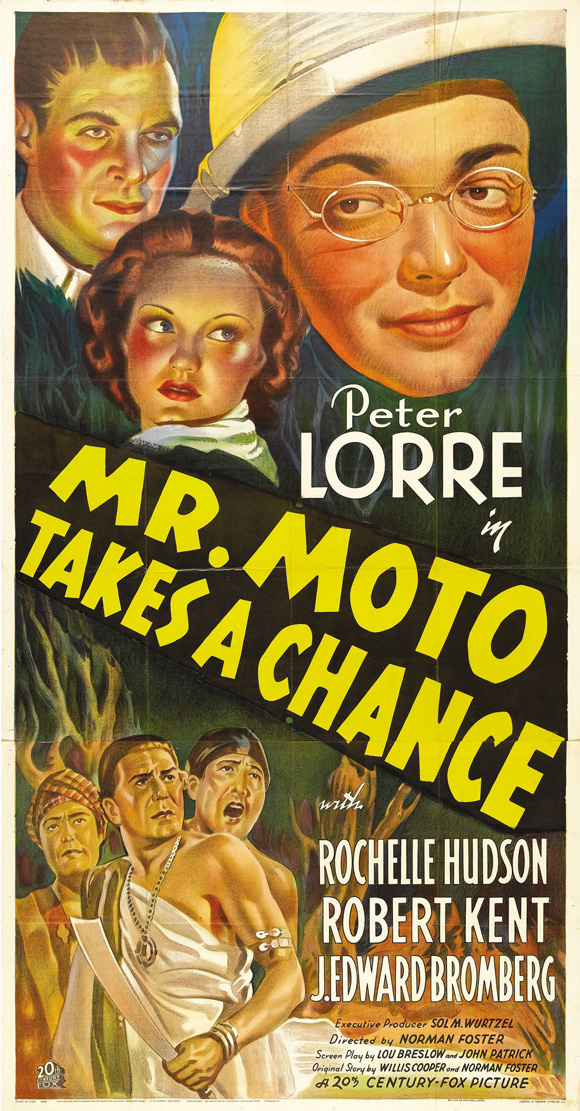
Mr. Moto Takes a Chance

Just when I thought I would be moving into less racist, more accepting/progressive roles, I go and watch this movie. Dear God.

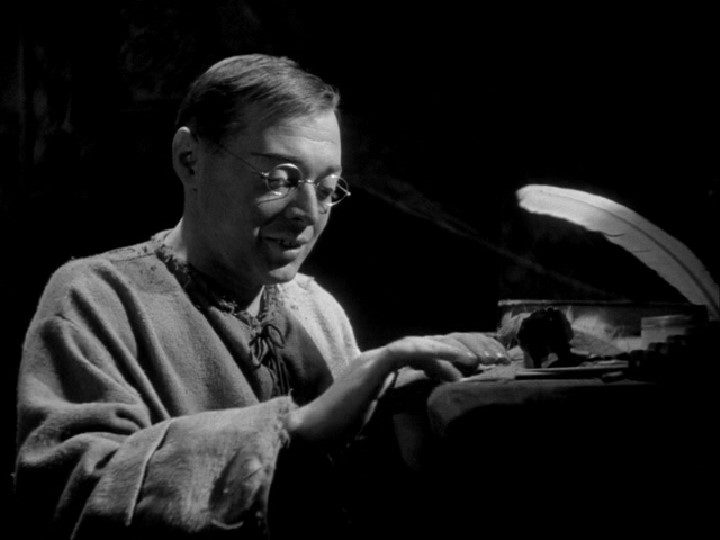
Mr. Moto Takes a Chance takes the Japanese secret agent to Angkor Wat in Cambodia, where he is spying on the king of the village/country/city of Tong Moi for unknown reasons. While he is there, an adventuress, Victoria Mason (Rochelle Hudson) "crashes" her plane after it "catches fire" (she set it with a flare) but survives and is taken to Tong Moi. Two reporters, Chick (Chick Chandler) and Marty (Robert Kent), are doing some wildlife filming when they spot Victoria's plane going down, so they rush on over to the crash site and do some filming. However, Victoria has already been taken to the King of Tong Moi (J. Edward Bromberg) by his magical adviser Bokor (George Regas) after meeting Mr. Moto (Peter Lorre), who is posing as an archaeologist. Marty and Chick catch up to Victoria, Bokor and the King of Tong Moi and want to film them. Unfortunately, the King's favorite wife drops dead from a poisoned arrow, but Bokor blames it on Marty and Chick's demon camera, and orders them to be taken away for a "trial by the gods." Bokor takes the two reporters to the Temple of Shiva where he burns them with hot metal and it hurts them (of course). This deems them guilty of their crime and they are about to be thrown in a big pit to die when an elderly guru interrupts them. The guru proves how magical and powerful he is when he doesn't get burned by the hot metal and he charms a snake, so he orders Bokor to let the reporters go. Bokor does so and he is mad. The next day, Moto approaches the reporters and tells them that he would pay a hefty price for pictures of the inside of the temple. Chick and Marty agree and go off towards the temple, but Victoria Mason follows them! However, when they arrive, Bokor and an unnamed servant try to kill them with poison darts too! They duck down and hide, and, lo and behold! The guru! He rescues them from Bokor and the servant but throws Chick and Marty's camera down the well. Bokor sees this, and contacts the guru after Chick, Marty and Victoria leave, and asks the guru if he can kill Moto. The guru agrees and returns back inside the temple. He digs around until he finds a secret trap door that leads to an underground room. In it, there are loads of ammunition. Then another unnamed servant climbs down into the underground room and tries to stab the guru, but the guru strangles the assassin with his own two bare hands! Then the guru runs away through a secret passageway, and reveals himself to be Mr. Moto in disguise! Mr. Moto then writes a secret note saying that Bokor is in charge of a rebellion against the King and that he (Moto) has found the secret stash of ammunition and sends it off via carrier pigeon. The carrier pigeon is then shot down by the King of Tong Moi, who sees the message and reads it. That night, the King hosts a big party with faux-Cambodian dancing and announces that he is going to marry Victoria Mason (airplane girl). He then serves roasted pigeon and gives the one that was a carrier to Mr. Moto, who finds a message on it and realizes the King found out his secret! Later that night, Moto is marking the ammunitions cellar on a map when Bokor and another unnamed servant attempt to stab him. But, in a display of badassery, Moto stabs the servant with his own knife, takes the servant's clothes and runs away. Victoria Mason goes to visit Mr. Moto but finds the stabbed servant. She pokes around in the itty bitty house until she finds Mr. Moto's map hidden in a spear. Bokor spots her and throws a dagger at her, which misses her narrowly. She is then kidnapped by Bokor and taken away to the Temple of Siva for questioning! They are about to subject her to the hot metal torture until - huzzah! - the guru appears. He "hypnotizes" Victoria and whispers to her that he is Mr. Moto. Victoria follows along and is a good hypnotee, until Marty (who followed them to the temple) bursts in and attacks guru/Moto and "rescues" Victoria, although he ends up getting tortured too. Bokor commands his nameless servants to light bonfire signals so that this one Captain Zimmerman (Frederick Vogeding) can bring him his guns. Bokor wanted the guns so that he could overthrow the King and "[drive] every foreigner from Asia!" Then he has his unnamed servant shoot Captain Zimmerman and Victoria lets slip that the guru is really Mr. Moto. Then Mr. Moto busts out his karate chop hands and fights everyone. Bokor escapes and rounds up the rest of Zimmerman's men, while Moto, Victoria, Marty, and Chick (who tagged along) become friends and find guns in the temple. There is a big shootout between our Fab Four and Bokor and Zimmerman's dudes, and Chick gets shot in the arm. Then Victoria Mason reveals that she's not a plane girl - she's a spy! And Mr. Moto reveals that he isn't an anthropologist - he's a spy! They're both spies! Then the King arrives with his troops and goes after Bokor and Bokor's guys - but the King wants to take Bokor's ammunition and stage a revolt against the French! The King is revolting! He plans to kill Marty, Chick and Mr. Moto but Victoria distracts him and somehow the King ends up in the ammunition cellar, which Mr. Moto sets fire to. Everyone except the King escapes from the temple before it blows up. And then our Fab Four gets on a boat to go... somewhere else. The end!

"No devil in box, just a movie camera! Miss Mason, will you tell Dracula there that we're not gonna hurt anybody?"
You know how everyone talks about how racist the stereotype of Charlie Chan is? Mr. Moto takes the cake. 
God, the yellowface. It's so awful. I had never seen any prosthetic teeth until I watched Breakfast at Tiffany's with my best friend Mr. Yunioshi. These are some serious prosthetic teeth. They don't stick out as much as some caricatures that I have seen, but these are pretty bad. They're large and black around the edges. They're just silly, and painful to look out. And some pretty serious taping of the eyelids. If you look at Peter Lorre's real teeth, they're not much better. But would his teeth be forgiven because he's really Hungarian? Lorre also adopted a horrific accent for this too - lots of slurring of the speech and mixing up the "r"s and the "l"s - pretty standard "Oriental" accent, but it's worse than Charlie Chan's (lack of an) accent. He also says "Oh so?" all the time. All the time. Every time there is something of interest, it gets the "cute" little "Oh so?" and an inquisitive bow. Of course, you can't tell if Peter Lorre had his skin darkened in order to appear more "Japanese," but the bows at the waist, the buckteeth and the slanty eyes are enough! Shame! 

"What do you make of that gravedigger?" "If I was castin' a horror picture, I'd have him play the murderer."
The character of Mr. Moto was created in response to the death of Earl Derr Biggers, author of the Charlie Chan novels. Once there were no more fresh Charlie Chan novels, readers needed another Asian sneaky guy to satisfy their Oriental mystery fetishes. Enter Mr. Moto. 
Mr. Moto is sly and sneaky and smiley. He knows martial arts (judo, jiu-jitsu). He is more than adept at disguise. He speaks 4 languages. He works alone. If Jackie Chan is the son of Charlie Chan, then Bruce Lee is the son of Mr. Moto, and Moto is the brother of Mr. Yunioshi. It's a whole family of stereotypes! But I digress. Mr. Moto is (possibly) an even more damaging and offensive caricature than Charlie Chan. He's not as subservient as Charlie Chan is - he's more sly and shifty and doesn't seem to be trusted by anyone, whereas Charlie Chan is everyone's favorite roly-poly, subservient detective. There's also the fact that Mr. Moto is a secret agent - it's his job to deceive people. Coupled with the fact that during this time, the Japanese were the "bad Asians," this makes a caricature of Japanese men (showing them as manipulative and untrustworthy). It's really disgusting. 

"Them Nipponese sure are peculiar birds."
In contrast, I've seen a lot of accounts that state that Mr. Moto is not a racist portrayal after all. They state that his politeness, combined with his cleverness, presents a sort of heroic character. It's insinuated that Mr. Moto is a sympathetic character, regardless of his shiftiness in the beginning of the story and how you don't learn he's a good guy until the very last 10 minutes of the film. They also state that while casting Warner Oland as Charlie Chan and Luise Rainer as O-Lan in the Good Earth was racist, casting Peter Lorre (a white guy) as Mr. Moto was not racist. Uh, what? Mr. Moto is just as humble and polite as Charlie Chan - why does the casting make any difference at all? Was it because Peter Lorre regularly played evil characters, and the role that turned him into a star was a (slightly) more sympathetic role? 

"Everything is possible here in the Orient."
What's really interesting is that this movie takes place in Cambodia. Cambodia? Really? What happened to things happening in Shanghai, or Canton, or Beijing, or something? Cambodia? This seems to be very odd... It seems to be the beginning of this division between East Asians (Japanese, Chinese, Koreans) and Southeast Asians (Cambodians, Vietnamese, etc.) and it's not... all... that great. Everything in this movie is fetishizing Cambodians and making them into mysterious, bloodthirsty savages! Evil Cambodians took away the reporters! Evil Cambodians burned the white reporters with a hot metal rod! They threatened to throw the white reporters into a deep dark well! One white reporter fell into  a mysterious tiger pit! Evil Cambodians assassinated the King's favorite wife with a dart-gun-thing! Mysterious Cambodian dancers who are really white danced around as entertainment to the white male guests! Victoria Mason was going to have to marry the Cambodian King of Tong Moi! Mysterious killing Cambodians! They tore off her shirt threatened to burn Victoria Mason with more hot metal! Oh no! It's all... so... bad!
"There's something about those ruins that Mr. Moto wants to find out, and it isn't archaeology!"
There are very few Asian extras in this film. Most of them portray servants and peasants, whereas the harem women are all white as white can be. I don't think there's a single sympathetic speaking role for any actual Asian actor in this film. It's become so expected that it isn't bothersome anymore - it just is. The fact that there are lots of unnamed Asian extras seems to justify the whiteface - but it really doesn't. It's all disappointing.

Thursday, January 20, 2011

Charlie Chan in London

Charlie Chan isn't dead yet. Unfortunately. 

Charlie Chan in London takes Charlie to a large country house in London where he solves another fantastic, mind-boggling crime. In short: Condemned man was framed but his sister doesn't want him to die because she's convinced of his innocence. Condemned man's sister hires Charlie Chan to find that condemned man is innocent, which he is. Charlie Chan sets a trap and finds the real killer. But the plot isn't important. Charlie Chan is who's important here. 

Remember how I thought that watching Charlie Chan in an All-White Setting would be much more interesting? It really wasn't. If anything, Charlie Chan was even more humble,  subservient, annoying and extremely foreign. He was "Much honored to be of humble service to British lion" by inspecting the case of Condemned Man. His "humble eyes have had much practice" at making large deductions from tiny details (Sherlock Holmes ripoff, anyone?). When complimented on his deducting skills, he responds with "World is large. Me lowly Chinaman" with a simpering smile. He reminds the audience and his suspects that he's (most importantly) a foreigner - "Regret do not understand English, only American." and "Lowly Chinaman here!" and "[I am] Oriental, not British." and "Not very good detective. Just lucky old Chinaman." It's sickening. 

Because the character of Charlie Chan is played by a white man, shown belittling himself to everyone, and (essentially) a parody of all subservient Asian men, it is one of the more damaging stereotypes out there. I've said this before, haven't I? Along with Charlie Chan being a non-threatening (to other-than-Asian people) stereotype, it's also a very self-incriminating one. It shows that Asian men are ready and willing to demean themselves, but the fact that the character is portrayed by a white man (Warner Oland, no less) makes the entire thing a parody of the Asian man and someone (or something) not to be taken seriously. 

There is a character of a newspaper reporter in Charlie Chan in London that cannot seem to call Charlie Chan by his correct last name. He continues to call Charlie "Mr. Chang." It's always, "I see what you're driving at, Mr. Chang!" or "Mr. Chang enjoys his joke." And not once does anybody bother to correct him. Charlie Chan never bothers to correct him, the other unimportant people at the country house don't bother to tell Mr. Ignorant Reporter off either. What is this? Is this racism? Is this being anti-Asian, by refusing to say Charlie's last name right? Mr. Ignorant Reporter is a bit of a caricature himself, with his bushy handlebar mustache and his pseudo-British accent. Was messing up the Honorable Detective's name part of the caricature? Was it intended for comic relief or just... something random? I cannot decipher what purpose the messing up of the name was, or whether I'm just overanalyzing. I really cannot tell. 

Then there's the xenophobic, neurotic housemaid with an absurdly fake cockney accent. she's convinced that the Honorable Detective is a hypnotist (Fu Manchu anyone?) because he climbs through a window to talk to the Sister of Condemned Man. She's suspicious of the Honorable Detective because he's a foreigner ("There'll be death in this house until we get rid of that creeping, murdering foreign man!"). Homegirl is off her rocker. She represents all the people who remained suspicious of Asian people in general during this time period; however, I can't tell if her character is supposed to be there for comic relief or if she's just reminding the audience that no matter what, we can't trust the foreigner, even if it is our good ol' buddy Charlie Chan. 

Something that gets me every time I see a clip of Charlie Chan talking, I am struck by how little of an accent Warner Oland puts on. His speech is just slowed down with the funky syntax and grammar thrown in. There's no mixing of the r's and l's, no obvious, exaggeration or appropriation of an "Oriental" accent. I wonder if this was because Warner Oland never met an Asian person, so he didn't actually know how to do the inflections and whatnot? What it just lack of knowledge that kept the character of Charlie Chan from adopting a "real" Asian/Chinese accent throughout the productions.

Would Charlie Chan having a thick "Oriental" accent increase or decrease the amount of offensiveness in the stereotype? I honestly don't know. While I'm bothered that Warner Oland didn't do any research for the role in terms of the vocal performance, I'm also relieved that he didn't because it could have hurt the character's connotations so much more. The lack of research implies a slightly arrogant dismissal of the fact that some Asians do have accents, and it's a bit insulting. But I wonder if it would be twice as insulting if he did do research and try very hard to adopt a really thick, heavy "Oriental" accent. The fact that it would be a drunk Warner Oland (need I remind you that he's Swedish?) with a false and exaggerated accent, combined with the aphorisms and humbleness and subservience - the Charlie Chan stereotype would push a lot more buttons than it does already. An exaggerated accent would definitely add some weight to the whole "Perpetual Foreigner" thing - and not in a very good way (Captain Obvious reporting for duty). 

Some aphorisms before you leave:
-Front seldom tell truth. To know occupants of house, always look in backyard.
-Case like inside of radio - many connections, not all related. 
-When death enters window, no time for life to go by door.  

Wednesday, December 15, 2010

Looking Backwards

Warning: Somewhat incoherent and wiggly wonderings ahead. Enjoy!
As the year/semester draws to a close, I have begun thinking about all of the things I've learned, gotten mad at, felt offended or inspired by, or that have just left me speechless. 
It's daunting, actually, to scroll back through all my other posts and summarize what I've learned. It's like completing grade school and then having to go back and remember what you did on the 100th day of school in kindergarten. Daunting.
Before I went into this study/blog/craziness, I had relatively little understanding of how Asians have been represented in the media, how they have been treated in America, and how it continues to exist today. I had virtually no idea about what it means to be Asian American. 
I'm not saying that because of this blog I've had this great epiphany and I know and understand every single Asian American's experience. Instead, I have a deeper understanding of the stereotypes that still exist today and a better understanding of why I may have perceived something as racist (with historical context to boot). 
What are the connections between social and historical forces and the representations we see?
Why is yellowface still acceptable? When and how did yellowface turn into whitewashing?
How do these representations create and/or perpetuate stereotypes that are present in our world? What is the impact?
These questions have been hanging over my head all semester, and I keep wondering if I'm answering them fully. Or if I'm keeping them in mind as I type and try to analyze the movies and television shows I see. Or if my readers even stopped to read these questions. Sometimes I'm even wondering if these stereotypes matter. I know that's a blunt way of putting it, but what if nobody else sees the things I do? Is it my job to get up on my soap box blog and tell the world about these stereotypes and how damaging they are? Do people care? I care. That's kinda why I did an Independent Study in it...
I'm also wondering if yellowface is acceptable to other people, or if it's even part of society's consciousness. I've read so many comments on the IMDB listings for the movies I've watched that have yellowface, and they all say things like, "Ignore the fact that there's Caucasian actors playing Chinese people, this movie is awesome!" Or "I don't think this movie is racist. It's so funny when the white guy imitates the Oriental!" Or "LOL i luv jake gyllenhaaaaaaaaaal!!!!!!11111!!!!1!!!!!1111111111!!!!!1" These comments make me not only concerned about the state of humanity, but also whether or not yellowface is accepted and... liked? Or is it even given a second thought except for me and a few other people? 
Look at my first post ever. I've come a long way. Seriously, I have.
Be prepared for 2011. Even more analysis and soap box soliloquies to come. 
More reflections to be posted in the comments section below!
 

Tuesday, November 23, 2010

One of Our Dinosaurs is Missing

Just when we thought there was going to be a lot more movies with some REAL representation, this little film came along and screwed everything up. 
London, 1923. Lord Southmere (Derek Nimmo) is a Queen's messenger and he has just arrived from China with a piece of microfilm concerning the mysteeeeerious "Lotus X." A group of Chinese spies find out and try to capture him, but not before he puts the bit of microfilm on the bone of a dinosaur in the Natural History Museum. Along the way, he enlists the help of his old nanny, Hettie (Helen Hayes) and her fellow nanny Emily, to thwart the Chinese spies. They are then captured by Hnup Wan (the "inscrutable" Peter Ustinov), the head of the London division of Chinese spies, whose old nanny was friends with Hettie. However, the nannies escape and plan to help Lord Southmere escape as well. Meanwhile, Lord Southmere won't tell Hnup Wan and his right hand man, Fan Choy (Bernard Bresslaw) where the microfilm is. All they know is that it was hidden on a dinosaur in the Natural History Museum - so they decide to steal one of the dinosaurs in order to find the microfilm. The Chinese spies load the dinosaur onto a truck in the middle of the night, but before they can run away with it, the nannies steal the truck and the dinosaur, with Hnup Wan and Fan Choy following close behind. There's a long chase scene, which ends in the dinosaur and truck accidentally running onto a flat wagon of a train, and the nannies and the dinosaur are carried away. The nannies continue to look for the microfilm but are forced to conclude that it just isn't on the stolen dinosaur. Then a little boy points out that there are multiple dinosaurs in the museum, and everybody realizes that the Chinese spies and therefore the nannies stole the wrong one! Hnup Wan gets to the dinosaur first and finds the microfilm of "Lotus X," which he prepares to look at properly, until Fan Choy replaces Hnup Wan as the head of the London division of Chinese spies. The nannies have now realized that Lord Southmere is in danger, so they recruit other nannies and they fight the Chinese spies in a Chinese restaurant, and Hnup Wan saves Lord Southmere. Later, everyone gathers in Hnup Wan's office to see what "Lotus X" was. And the piece of microfilm that started this whole mess turns out to be a recipe for wonton soup. And everyone is happy. 

Wonton soup???? Are you serious? All that plot for wonton soup? Not only is that just stupid... it implies that Chinese people only really care about food! It shows us as greedy gluttons who desire only to keep our precious wonton soup recipes to ourselves! Disgusting!
One of the most racist portrayals I have seen so far is from a children's movie. Horrifying.
Remember how I kept saying in previous yellowface portrayals that the accents weren't all that noticeable or prominent? How they were really only slowing down their speech or using an ambiguous accent that wasn't really specifically Asian? This is the first film I have watched that has that stereotypical, over exaggerated accent. One of Our Dinosaurs Is Missing is just the most God-awful representation of someone of Chinese descent that I have seen yet. Every "r" gets mixed up with every "l." The speaking characters add the suffix "-ah" to every other word and butcher the English language shamelessly. Ustinov and Bresslaw employ a funky gutteral "nnnnnnnnnnnnn" noise after every sentence. When Ustinov reads "Chinese" out loud it sounds like this: "foy toy mee shee loo mah tung ah..." 
Then there's the yellowface. It consists of some crazy taping of the eyelids, some blue (blue?) eyeshadow, and some Charlie Chan-esque facial hair. It doesn't sound like much, but man oh man... It's terrifying. It's blue, sparkly eyeshadow! What about smearing blue sparkly eyeshadow across an actor's eyelid makes them Chinese? Absolutely nothing! Interestingly, there was no darkening of the actor's skin or prosthetic buck teeth. Not a single Asian person was seen in this movie either. All of the extras were white men as well, unlike Good Earth or Bitter Tea of General Yen, which at least had the good sense to at least include extras... Combine this level of scary yellowface with the heavily exaggerated and ugly ugly accents and you have got some scary Chinamen.
Hnup Wan is a bad Charlie Chan and a friendly Fu Manchu. He is roly-poly and bumbling like Charlie Chan, and is mysterious, manipulative and sly like Fu Manchu. He dresses in Western clothes and sometimes employs stupid aphorisms like Charlie Chan. He has crazy henchmen like Fu Manchu. Hnup Wan has the Charlie Chan facial hair and the Fu Manchu super-slanty eyes. He is asexual like Charlie Chan and employs funky-strange torture methods like Fu Manchu. And this character was in a children's movie (Ironically, he was played by Peter Ustinov, who then portrayed Hercule Poirot, which is most definitely a Charlie Chan parallel). 

The big fight scene between the nannies and Hnup Wan's henchmen is awful as well. It shows little old nannies beating up kung fu masters. Painful! But that's not all! The "masters"aren't even doing kung fu, or any martial art I know of. They're jumping in the air, doing a pirouette, then landing with a high kick and a hair-raising "HOOOAAAAAAAIIIEE!" Cue karate chop hands. Dear me. Two years after Enter the Dragon and you can't even hire proper martial artists? Shameful. 
Even more terrifying is that this was a Disney film. A children's movie. Hnup Wan and Fan Choy (Heavens to Betsy, those names!) are in the movie for comic relief and as the antagonists. On the one hand, this presents the Asian (male? There are no Asian women in this film at all) as a bumbling, slightly stupid and funny person that is really only good for making fun of. On the other hand, it shows the Asian as one who is sly, manipulative, cunning, dastardly clever and mysteeeeeeeeerious. These contrasting (conflicting?) portrayals end up sending only one message: Make fun of Asians because you can and because it's funny. One reviewer on IMDB wrote about how seeing this movie in theatres led him to do Hnup Wan impersonations. Is that a good thing? Absolutely not. That's like asking the Asian kids on the playground to do Long Duk Dong impersonations despite the obviously painful connections. In fact, Hnup Wan, Fan Choy, Mr. Yunioshi, and Long Duk Dong all belong in a new, separate category - Stereotypes That Exist Solely For Comic Relief and Playground Taunts.

Not cute at all. Listen to that soundtrack. It's got a stupid little xylophone. And the stupid little flutes and zithers and CRAP? It's racist! It sounds like the Mr. Yunioshi theme, only... mysterious. Gross. Makes me wanna cry. This stuff makes Flower Drum Song sound good. 
Children's movies relying on caricatures and stereotypes for comic relief? Shameful. 

Wednesday, November 10, 2010

Mr. Yunioshi

Make it stop!!!!!
"The worst of the worst
The most hated and cursed
Is the one that we call [Mr. Yunioshi]"


Look at his buck teeth. The intense yellowface - hello major darkening of the skin and some scary slanted eyes. The awful, stilted accent. The screechy, "Ah so!" when he pops up out of the bathtub. The yelling of "Miss Gorightry!" The portrayal of a cranky, nearsighted, short and stereotypical Japanese man - a step away from the direction that Crimson Kimono was going in. There is nothing pan-Asian-ist about Mr. Yunioshi. He wears a kimono, and his name isn't exactly one you could apply to any old "type" of Asian - it's specifically Japanese. Oh, the irony. 


Depressingly enough, Mr. Yunioshi was a character in the Truman Capote novella of the same name - and he was referred to as "that Jap." And that doesn't need much explanation, does it? Thankfully, he doesn't make many appearances in the book; however, he becomes a more prominent character in the film version, acting as Holly Golightly's landlord and lighthearted, blatantly racist "comic" relief. 
The fact that this is Mickey Rooney from Babes in Arms and all that Andy Hardy stuff is (for me) absolutely heartbreaking and disappointing. Mickey Rooney. Dear old Mickey Rooney from Night at the Museum 1. The guy who voiced Kris Kringle in that stop-motion version of Santa Claus Is Comin' to Town. Mickey Rooney donned some of the worst yellowface I have seen so far and got praise and recognition for it. The New York Times wrote of his performance: "Mickey Rooney's bucktoothed, myopic Japanese is broadly exotic." Everyone loved it. Everyone thought it was hysterical and funny and... accurate, apparently. Of course, he has since apologized for the portrayal, saying that "It breaks my heart. Blake Edwards, who directed the picture, wanted me to do it because he was a comedy director. They hired me to do this overboard... Never in all the more than 40 years after we made it -- not one complaint. Every place I've gone in the world people say, 'God, you were so funny'... It's terribly sad and I feel bad for the people taking offense." He even said later that he wishes someone had told him about how his portrayal might be a bit offensive, because then he would have changed it. Blake Edwards even said, "Looking back, I wish I had never done it...and I would give anything to be able to recast it, but it's there." But do you see how uninformed Blake Edwards and Rooney were? They wanted to use the "Jap" as comic relief, as a throwaway character with no real importance without thinking of the repercussions this portrayal had. Does their ignorance make them racist? Mr. Yunioshi is undoubtedly a racist caricature, but does this mean that their creators are racist? They both seem to have been expressing remorse for their interpretation and regretting the portrayal - but that doesn't change the fact that thousands of people saw the film, saw the portrayal, and unconsciously (or consciously, take your pick) applied it to all Asians (or all Japanese, take your pick). This film was made in a time when you would not have any blackface whatsoever, but it was apparently okay to make fun of Asians! Why? Is this the model minority thing? We won't raise a stink about an unfavorable portrayal, while other minority races will? Disgusting. 

Play that [chinky] music, [Henry Mancini]? Hear those xylophones and the jazzy "Oriental" music? Every time I hear some sort of cinematic "Oriental" music, it makes me want to curl up in a ball and cry. It's so false and situated around gongs and zithers and that stupid little riff - you know, the "dunh-nuhnuhnuh-nuh-nuh-nuh-nuhhhhh" one. And get this! Most of the time, the scores that sound like this one wee written by white composers! Who knew?! Now is it offensive and annoying because it was written by a white composer? Or is it offensive and annoying because we hear it so often in conjunction with movies that have offending and questionable portrayals of Asians in them? Are the connections and connotations between the acting and the music what annoy us? Or is it the music itself? After listening to the above song, I'm going to say it's a mixture of both.
Some argue that Charlie Chan or Long Duk Dong have been the most damaging stereotypes to the Asian/-American community; however, I feel that the cheap "comic" relief provided by Mr. Yunioshi stands out as an extremely racist portrayal. In case my readers (hello, all!) haven't noticed, I tend to refrain from using the word "racist" to describe certain portrayals because I feel that it's a very strong word to use. Other portrayals I tend to use "stereotyped" or "wrong," and I think that most of those stereotypes are. They definitely have racist undertones, but it depends on whether the portrayal is (I think) a trying-to-be positive portrayal or not. Something may have racist undertones, but it may not be blatantly and negatively racist. If I apply the word "racist" to every portrayal I come across, it will lose it's meaning. That said, I think that Mr. Yunioshi is one of the most extremely racist caricatures - he's right up there with Fu Manchu. He has none of the "Oriental wisdom" that Charlie Chan (detested as he is) possesses. He is not polite or subservient to anyone (that could be a good thing, but then again, no). He is the perpetual foreigner - he has an awfully exaggerated accent and... dear lord the buck teeth. Everything about Mr. Yunioshi is just too much to handle. Makes me want to cry. So awful. He sends the message (loud and clear!) that this was an acceptable way to portray Asians - or, specifically, Japanese people. This was 1961 - you'd think people would have seen this as racist - but did they?? Apparently not! They considered this hysterical! Funny! Comic relief! Blatant racism!!!
If you fast-forward through every Mr. Yunioshi scene, it's a decent movie. It's just the awful stereotype that ruins it. Whoopee. 

Thursday, October 28, 2010

Charlie Chan: The Untold Story of the Honorable Detective and His Rendezvous with American History by Yunte Huang


As a hater of Charlie Chan, I went into this book knowing that I'd be reading a lot about Earl Biggers' inspiration for his series, the actual detective Chang Apana, and the historical/social forces that went into and surrounded the book at the time. I really enjoyed Huang's easy-to-understand, interesting analysis of Charlie Chan in Shanghai and other Chan films, in addition to the books and characters. I found his comparison sections between Fu Manchu and Charlie Chan especially intriguing, because I myself have been contemplating that relationship and Huang's analysis was even more eye-opening in terms of my studies here. The most interesting and thought-provoking part of the book was (for me) the section where Huang, an admirer of Charlie Chan, cites Frank Chin's essay on Charlie Chan, which clearly illustrates Chin's distaste for the character. The contrast between the two viewpoints and the surprising connections between the two really shocked me (in a good way) and it made for an even more in-depth but easy-to-understand read. However, I wasn't expecting some of the autobiographical things that managed to slip themselves into the book at all. In fact, I found them rather unnecessary and a little distracting to either the storyline about Chang Apana's life or the cultural impacts of Charlie Chan. Overall this was a great book and I'd recommend it to anyone.

Wednesday, October 27, 2010

Charlie Chan Pt. 2

Remember how I hated Charlie Chan so much in my previous post about him? How he's essentially a yellow Uncle Tom? Yeah, well, China loved him. China loved a fictional character created by a white man and played by a white man. After years and years of Fu Manchu movies and Fu Manchu-esque characters, why not embrace the one semi-positive character that came around? Charlie Chan was honorable, venerable, humble, and intelligent. What's not to love? 
Even if he is a glutton... desexualized... awkward... roly poly... overly subservient... speaking in pidgin English... effeminate... essentially the father of the model minority stereotype (not mention all 14 of his children).
Charlie Chan assimilates well. He rejects his "native/ethnic" garb for a Western suit and hat. Mr. Chan still remains the same wise old Chinese sage and spews "Chan-isms" that are adorable in their broken English yet incredibly all-knowing (i.e. "Man who fights law always loses; same as grasshopper is always wrong in argument with chicken." Confucius say what?). He is filled with all the wisdom of "the Orient," even if his proverbs do not make any sense at all, and no Asian proverb I've ever heard is as weird and annoying as one of Chan's aphorism. Charlie is a teetotaler, only occasionally having a sarsaparilla - if he doesn't drink, he's not exactly liable to get raging drunk and go out on a (fill in the blank) spree, is he? Charlie Chan sucks up to white people by calling them "venerable," "honorable," "distinguished..." Model minority, anyone? 

See why China loved Charlie Chan? I hate him for exactly the same reasons. While Charlie Chan is not a downright racist and negative stereotype, it is the alternative to Fu Manchu. It presents a stereotype about Asian men that they are bumbling, gluttonous, kooky eunuchs that have nothing on their mind but their work. There was nothing threatening about Charlie Chan - he wouldn't rape your women, steal your money, or try to take over the world. Several decades later, you see the beginnings of the Asian geek - the asexual, bespectacled math nerd with no girlfriend and fewer friends. While Charlie Chan is not the downright negative and offensive character that Fu Manchu is, the stereotype of the "honorable" detective is just as demeaning and painful to watch. Let me join in with the rallying cry of Jessica Hagedorn - "Charlie Chan is dead!" Good riddance! Let's all say it together - "Charlie Chan is dead, despite Yunte Huang's new book!" Ta-ta for now and forever, Charlie, you Fu Manchu foil! You're not much better than he is! 
Charlie Chan was created at a time when America was not allowing Asians to become citizens. Because there was a lot of anti-Chinese sentiment in the air, you'd think that a stereotype like the scary-sexualized and dictatorish Fu Manchu would be having field days all over the place, but no. In came Charlie Chan, showing Asians (namely Chinese) in a more positive, albeit demeaning light. In later years, after Chan had become very popular, his anti-Japanese sentiments became praised and seen as an added bonus of the character. This was when the Japanese were feared and the Chinese became the "good" Asians - the ones with whom whites could socialize.

The similarities between Charlie Chan and Hercule Poirot are uncanny. Both are rotund, "adorable" detectives. Both foreigners. Both have some funky facial hair going on. "'He was very fat indeed, yet he walked with the light dainty steps of a woman,' Biggers wrote of Chan. 'His cheeks were as chubby as a baby's, his skin ivory tinted, his black hair close-cropped, his amber eyes slanting.' Take out the 'slanting amber eyes' bit and you've got Poirot." (citation"He was hardly more than five feet four inches but carried himself with great dignity. His head was exactly the shape of an egg, and he always perched it a little on one side. His moustache was very stiff and military. Even if everything on his face was covered, the tips of moustache and the pink-tipped nose would be visible. The neatness of his attire was almost incredible; I believe a speck of dust would have caused him more pain than a bullet wound. Yet this quaint dandified little man who, I was sorry to see, now limped badly, had been in his time one of the most celebrated members of the Belgian police." (The Mysterious Affair at Styles, Ch. 2) Here's a confession - I love Hercule Poirot. I love him for his fastidiousness and the parlor room scenes where he accuses one person, proves them innocent, and proceeds to accuse and arrest the really guilty person. But what would somebody who is Belgian think of Poirot, created by English writer Agatha Christie? Do people who are Belgian have the same reactions to Poirot that Chinese/Asian-Americans have to Charlie Chan? 

Charlie Chan is the gateway into the model minority and the emasculated Asian male, whether it is the Charlie Chan of the books, the movies, or the television shows. Annoying Crap Hall of Fame? Yes. 


Brilliant radio interview with Tom Ashbrook, Yunte Huang, author of "Charlie Chan: The Untold Story of the Honorable Detective and His Rendezvous with American History" and writer Frank Chin.
Frank Chin and Yunte Huang THROWDOWN - Frank Chin gets a little... over the top...