It's the start of a new semester and the start of some new theme exploration! Yippee!
What to Look Forward To:
1. More movies! More books! More television shows!
2. Possibly an entire section on children's TV shows and all their craziness.
3. Another collage!
But there will be less of this:
And more of this:
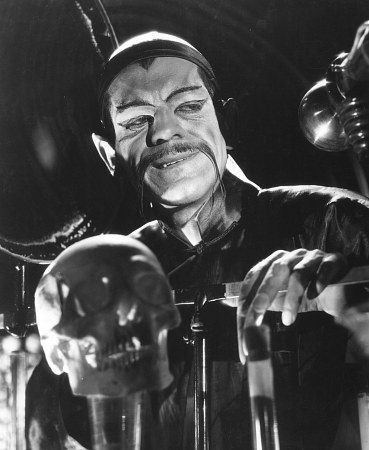
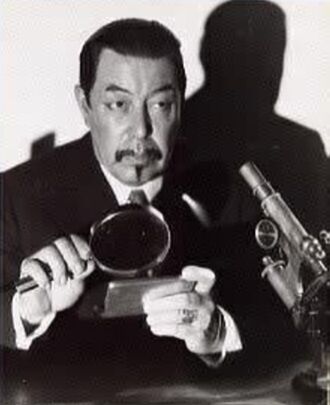
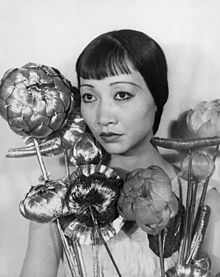
So there will be more of a focus on whitewashing and the positions that Asian American actors are in nowadays in the film industry than focusing on yellowface and its historical context and implications.
Huzzah!
Musings, rants, and other good stuff on the evolution of the depictions of Asians/Asian-Americans in television, films, and pop culture. Lick-Wilmerding Independent Study '11
Keep on Wondering...
What are the connections between social and historical forces and the representations we see?
Why is yellowface still acceptable? When and how did yellowface turn into whitewashing?
How do these representations create and/or perpetuate stereotypes that are present in our world? What is the impact?
Showing posts with label other good stuff. Show all posts
Monday, January 3, 2011
Monday, December 27, 2010
Wednesday, December 15, 2010
Looking Backwards
Warning: Somewhat incoherent and wiggly wonderings ahead. Enjoy!
As the year/semester draws to a close, I have begun thinking about all of the things I've learned, gotten mad at, felt offended or inspired by, or that have just left me speechless.
It's daunting, actually, to scroll back through all my other posts and summarize what I've learned. It's like completing grade school and then having to go back and remember what you did on the 100th day of school in kindergarten. Daunting.
As the year/semester draws to a close, I have begun thinking about all of the things I've learned, gotten mad at, felt offended or inspired by, or that have just left me speechless.
It's daunting, actually, to scroll back through all my other posts and summarize what I've learned. It's like completing grade school and then having to go back and remember what you did on the 100th day of school in kindergarten. Daunting.
Before I went into this study/blog/craziness, I had relatively little understanding of how Asians have been represented in the media, how they have been treated in America, and how it continues to exist today. I had virtually no idea about what it means to be Asian American.
I'm not saying that because of this blog I've had this great epiphany and I know and understand every single Asian American's experience. Instead, I have a deeper understanding of the stereotypes that still exist today and a better understanding of why I may have perceived something as racist (with historical context to boot).
What are the connections between social and historical forces and the representations we see?
Why is yellowface still acceptable? When and how did yellowface turn into whitewashing?
How do these representations create and/or perpetuate stereotypes that are present in our world? What is the impact?
These questions have been hanging over my head all semester, and I keep wondering if I'm answering them fully. Or if I'm keeping them in mind as I type and try to analyze the movies and television shows I see. Or if my readers even stopped to read these questions. Sometimes I'm even wondering if these stereotypes matter. I know that's a blunt way of putting it, but what if nobody else sees the things I do? Is it my job to get up on my soap box blog and tell the world about these stereotypes and how damaging they are? Do people care? I care. That's kinda why I did an Independent Study in it...
I'm also wondering if yellowface is acceptable to other people, or if it's even part of society's consciousness. I've read so many comments on the IMDB listings for the movies I've watched that have yellowface, and they all say things like, "Ignore the fact that there's Caucasian actors playing Chinese people, this movie is awesome!" Or "I don't think this movie is racist. It's so funny when the white guy imitates the Oriental!" Or "LOL i luv jake gyllenhaaaaaaaaaal!!!!!!11111!!!!1!!!!!1111111111!!!!!1" These comments make me not only concerned about the state of humanity, but also whether or not yellowface is accepted and... liked? Or is it even given a second thought except for me and a few other people?
Look at my first post ever. I've come a long way. Seriously, I have.
Be prepared for 2011. Even more analysis and soap box soliloquies to come.
More reflections to be posted in the comments section below!
I'm also wondering if yellowface is acceptable to other people, or if it's even part of society's consciousness. I've read so many comments on the IMDB listings for the movies I've watched that have yellowface, and they all say things like, "Ignore the fact that there's Caucasian actors playing Chinese people, this movie is awesome!" Or "I don't think this movie is racist. It's so funny when the white guy imitates the Oriental!" Or "LOL i luv jake gyllenhaaaaaaaaaal!!!!!!11111!!!!1!!!!!1111111111!!!!!1" These comments make me not only concerned about the state of humanity, but also whether or not yellowface is accepted and... liked? Or is it even given a second thought except for me and a few other people?
Look at my first post ever. I've come a long way. Seriously, I have.
Be prepared for 2011. Even more analysis and soap box soliloquies to come.
More reflections to be posted in the comments section below!
Thursday, December 2, 2010
Terminology. That's What.
Yellowface - the practice of putting a non-Asian actor (usually white) into makeup and prosthetics that alter the actor's appearance and make them "look" Asian. The actor will also usually employ some garbled interpretation of an "Asian" accent.
Fu Manchu - a catch-all name for the male Asian antagonists in movies that are evil and evilly Asian and Asianly evil. Sometimes will speak with an accent, sometimes without. Often portrayed as sly, manipulative, cunning, and in some cases, with an insatiable appetite for sex, usually lusting after white woman.
Charlie Chan - another catch-all phrase for the polar opposite of the Fu Manchu. A character that is a Charlie Chan or a son of Chan is subservient, "adorable," a kiss-ass to white characters, asexual (towards anyone in any race), often portrayed with a heavy accent.
Lotus Blossom/China Doll - a subservient, demure girl with no backbone and no feelings. Often shown as an innocent, beautiful sexual toy who is corrupted by and infatuated with white men. The accent or lack thereof changes with every role.
Dragon Lady - the female Fu Manchu. Often has a penchant for killing people or busting out some karate chop hands. She is fierce, cunning, manipulative, powerful and a dangerously sexy gold digger.
The Badass Mute - also known as the Bruce Lee, or, depending on the age of the character, a Mr. Miyagi. A buff and wise kung fu master who only speaks in proverbs and remains serene until it's time to kick some ass and then meditate. Sometimes a sexualized character, sometimes not. Enforces the idea that Asian people all have the innate ability to perform martial arts.
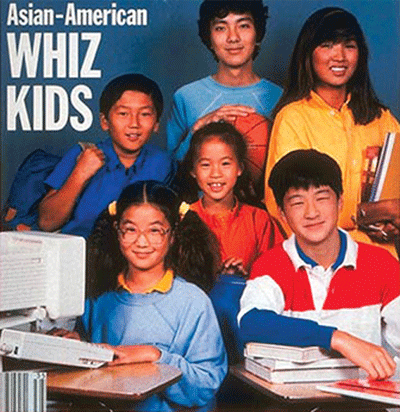
Model Minority - referring to a minority group who is considered "successful" in a society where the majority is not. When applied to Asians, it implies that they will keep their head down, earn perfect scores on their SATs, not make a fuss when made fun of. Asians are considered hardworking and incredibly smart in math and science, or piano prodigies. The model minority stereotype foists higher expectations on people of Asian descent to do well and be naturally good at everything, except perhaps having a backbone or be socially present in white-dominated society.
The Perpetual Foreigner - the assumption that Asians will never fully integrate into American society because of their race, and that they will always have an accent, always be loyal to their "mother country," and never be truly American. This is more of a subconscious stereotype that serves as a backdrop to the top 5 definitions listed here.
I'll add more later, promise.
Fu Manchu - a catch-all name for the male Asian antagonists in movies that are evil and evilly Asian and Asianly evil. Sometimes will speak with an accent, sometimes without. Often portrayed as sly, manipulative, cunning, and in some cases, with an insatiable appetite for sex, usually lusting after white woman.
Charlie Chan - another catch-all phrase for the polar opposite of the Fu Manchu. A character that is a Charlie Chan or a son of Chan is subservient, "adorable," a kiss-ass to white characters, asexual (towards anyone in any race), often portrayed with a heavy accent.
Lotus Blossom/China Doll - a subservient, demure girl with no backbone and no feelings. Often shown as an innocent, beautiful sexual toy who is corrupted by and infatuated with white men. The accent or lack thereof changes with every role.
Dragon Lady - the female Fu Manchu. Often has a penchant for killing people or busting out some karate chop hands. She is fierce, cunning, manipulative, powerful and a dangerously sexy gold digger.
Model Minority - referring to a minority group who is considered "successful" in a society where the majority is not. When applied to Asians, it implies that they will keep their head down, earn perfect scores on their SATs, not make a fuss when made fun of. Asians are considered hardworking and incredibly smart in math and science, or piano prodigies. The model minority stereotype foists higher expectations on people of Asian descent to do well and be naturally good at everything, except perhaps having a backbone or be socially present in white-dominated society.
The Perpetual Foreigner - the assumption that Asians will never fully integrate into American society because of their race, and that they will always have an accent, always be loyal to their "mother country," and never be truly American. This is more of a subconscious stereotype that serves as a backdrop to the top 5 definitions listed here.
I'll add more later, promise.
Monday, November 8, 2010
Thursday, November 4, 2010
Collagin' #9
Running out of witty things to say about progress...
Witty remark witty remark witty remark.
Huzzah!
Coming Soon:
Crimson Kimono
In-Depth Studies of Mr. Yunioshi and Long Duk Dong
Witty remark witty remark witty remark.
Huzzah!
Coming Soon:
Crimson Kimono
In-Depth Studies of Mr. Yunioshi and Long Duk Dong
Friday, October 22, 2010
Collagin' #7
Progress is a really cool thing
Progress is a really great thingSo get off your butt let's make some progress
Progress Progress PROOOOOGRESSSSS
![]() |
| Gluestick! |
![]() |
| Yes, I put googly eyes on Charlie Chan |
![]() |
Flower Drum Song
Charlie Chan Pt. 2
Enter the Dragon
Monday, October 18, 2010
Sunday, October 17, 2010
Yellow: Race in America Beyond Black and White by Frank H. Wu
It's a little concerning how long it took me to read this book. Warning: This is not a book you can read with your mind on your dinner.
Despite the fact that this book is not so easy to read, I thoroughly enjoyed this book. Wu's description of anti-Asian sentiments in America is compelling and interesting, going pretty in-depth into the origins of these stereotypes, and then gently bashing them to pieces. I particularly enjoyed his sections on "The Perpetual Foreigner" and th ...more
It's a little concerning how long it took me to read this book. Warning: This is not a book you can read with your mind on your dinner.
Despite the fact that this book is not so easy to read, I thoroughly enjoyed this book. Wu's description of anti-Asian sentiments in America is compelling and interesting, going pretty in-depth into the origins of these stereotypes, and then gently bashing them to pieces. I particularly enjoyed his sections on "The Perpetual Foreigner" and the model minority. Wu also tackles affirmative action, immigration, assimilation and intermarriage. One particular phenomenal chapter was about the "Dilemma of Diversity." Wu raised a lot of points that I found were really interesting and I had not thought of them before. I found that the examples and occasional anecdotes he wrote about I could relate to in some small way. Overall, this book opened up a whole new view on being Asian in America and what that means.
The subtitle of the book is "Race in America Beyond Black and White." Wu definitely goes into the contrasting of white and African American culture with a lot of really interesting analysis; however, I think I would have liked to have seen more contrast between white and Asian American perspectives or between African American and Asian American perspectives. That and the incredible denseness of this book...
A great read overall.
Despite the fact that this book is not so easy to read, I thoroughly enjoyed this book. Wu's description of anti-Asian sentiments in America is compelling and interesting, going pretty in-depth into the origins of these stereotypes, and then gently bashing them to pieces. I particularly enjoyed his sections on "The Perpetual Foreigner" and the model minority. Wu also tackles affirmative action, immigration, assimilation and intermarriage. One particular phenomenal chapter was about the "Dilemma of Diversity." Wu raised a lot of points that I found were really interesting and I had not thought of them before. I found that the examples and occasional anecdotes he wrote about I could relate to in some small way. Overall, this book opened up a whole new view on being Asian in America and what that means.
The subtitle of the book is "Race in America Beyond Black and White." Wu definitely goes into the contrasting of white and African American culture with a lot of really interesting analysis; however, I think I would have liked to have seen more contrast between white and Asian American perspectives or between African American and Asian American perspectives. That and the incredible denseness of this book...
A great read overall.
Friday, September 10, 2010
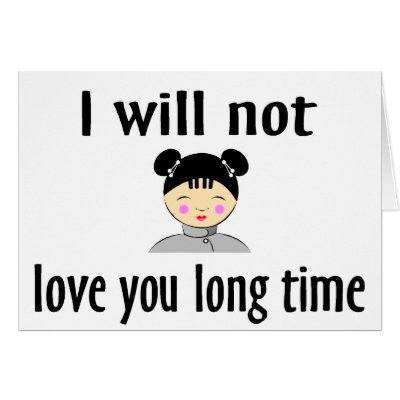
I Will Not "Ruv You Rong Time."
Recently somebody suggested I change the name of the blog to be I Will Not Ruv You Rong Time.
Clever, innit? But I began worrying about the more negative connotations that would have. I mean, a blog that's studying and trying to break down the racism that has shaped Asian-American perspective (in the most general sense) that has a title that has... a funky title... like I Will Not Ruv You Rong Time...
Perhaps I'm overthinking it. Is it okay for the title to be self-mocking and potentially problematic? Does the substitution of the "r" for the "l" make my blog seem racist or clever and witty? What's in a name?
That's my problem with the Internet and writing. Sarcasm is really hard to pick out. Really, it is. So I wonder, who would be able to find the potential new title as funny and witty and who would find it offensive?
The question remains. Should I or should I not change the name?
Clever, innit? But I began worrying about the more negative connotations that would have. I mean, a blog that's studying and trying to break down the racism that has shaped Asian-American perspective (in the most general sense) that has a title that has... a funky title... like I Will Not Ruv You Rong Time...
Perhaps I'm overthinking it. Is it okay for the title to be self-mocking and potentially problematic? Does the substitution of the "r" for the "l" make my blog seem racist or clever and witty? What's in a name?
That's my problem with the Internet and writing. Sarcasm is really hard to pick out. Really, it is. So I wonder, who would be able to find the potential new title as funny and witty and who would find it offensive?
The question remains. Should I or should I not change the name?
Tuesday, September 7, 2010
Collage-ing
The first 6 inches of what will be approximately 4 feet and 7 inches of crazy cutouts, sparkly paint and heavy symbolism.
Whoopee!!!
Subscribe to:
Posts (Atom)