Keep on Wondering...

What are the connections between social and historical forces and the representations we see?
Why is yellowface still acceptable? When and how did yellowface turn into whitewashing?
How do these representations create and/or perpetuate stereotypes that are present in our world? What is the impact?

Thursday, February 10, 2011

Dragon Seed

Another Pearl S. Buck novel made into a movie. Dear Lord. 

The story begins with Ling Tan (Walter Huston), the patriarch of his family consisting of his devoted and snarky wife (Aline MacMahon), his three sons Lao Ta, Lao Er, and Lao San (Robert Bice, Turhan Bey, and Hurd Hatfield, respectively) and the wives of two of his sons, Jade (Katharine Hepburn) and Orchid Frances Rafferty). Lao Ta and Orchid have two children together, a baby girl and a toddler boy. Lao Er and Jade have no children because they don't know they're in love yet (and I haven't even gotten to the real plot yet). Ling Tan and his wife (credited as "Ling Tan's wife") try very hard to keep the "old ways" going in the house, while Jade, who is a sort of pseudo-femme fatale, tries to tell them about the new ways of the world. The movie takes place during the Second Sino-Japanese War (which, honestly, I know very little about). "Evil dwarfs" from Japan invade the village near Ling Tan's farm after invading other parts of China and bombing the land, and soon take over, raping all the women and killing all the sons and eating all the food and being evildoers. The whole family joins a resistance group and begins killing Japanese soldiers and burying them under their floors. Even Jade joins in, poisoning some food and knocking out an entire regiment of Japanese soldiers. Eventually the Japanese are too evil to hang around, so all of Ling Tan's family (or what is left of them) up and leave for the mountains. The End.
There really is no plot to this movie. I mean, there is... But the first 30-45 minutes is just Jade and Lao Er getting to know each other and planting rice and reading books together. The next hour and a half consists of alternate shots of the Japanese being evil and Ling Tan's family taking revenge. That's all there is to it. 

The similarities between this movie and The Good Earth are uncanny. Both have subservient yet strong women who are not particularly beautiful but make good wives and bear sons. Both have supportive husbands who are also not particularly beautiful and love the fact that they have sons. Both movies have a stock character who is lazy and fat and a kissass. Both movies (and novels too, I guess) glorify the hardworking Chinese peasant while dismissing the upper class and royalty. Both stage large scenes of full-scale riots complete with fire and shouting and running and the works. I was a little freaked out by all the similarities, to be honest. 
Now this is scary. I've seen some pretty horrific yellowface but it's mostly been on males. This takes the cake for Female Yellowface. Look at those eyes. That's just... gross. 
I have nothing against the character of Jade. Jade is strong-willed and independent - it's great! She's no Lotus Blossom or China Doll - nor is she a Dragon Lady. Of course, she has qualities of a Dragon Lady (poisoning soldiers, being smart) but she lacks the sex appeal that the stereotypical young Dragon Lady has. However, I dislike the way Katharine Hepburn portrayed her. There are two interpretations of her portrayal. One is that Hepburn played herself in yellowface. Vocally, this is very true. It sounds just like Katharine Hepburn being Katharine Hepburn. The other is that she took Luise Rainer's interpretation of O-Lan and made her more of an outspoken feminist but kept the same physical qualities. Both O-Lan and Jade employ coy tilts of the head to express their love for their homely husbands and seem to be meek and hesitant with their movements. 
The purpose of this film was to glorify and build sympathy to the Chinese and to make Americans hate the Japanese. It's quite easy to sympathize with the Chinese characters of the film - they are hardworking, loving, and peaceful, sacrificing themselves for their children and fighting back against the "Evil Dwarfs" that are the Japanese. They are also all portrayed by white people - not actual Asians. And the cameo of Benson Fong doesn't count - he plays a militant hater of the Japanese who takes his anger out on Ling Tan's merchant brother-in-law. However, the Chinese children in this movie are actually played by Asian children. And they are pretty darn cute - just their wide eyes and chubby cheeks elicit prolonged "Aaaawwww"s from the audience, I guarantee you. This makes it even easier for the American audience to sympathize and end up caring about the Chinese. Remember, this film was released during 1944, towards the end of WWII. China was, at the time, our ally, and Japan was America's enemy. The film then shows the Japanese as cunning, sly, evil men with large teeth and an insatiable appetite for women and wine - they're all Japanese Fu Manchus! A group of them attack, rape, and kill Orchid after she is caught by them trying to hide her children. Another group of them kill Ling Tan's mother in his courtyard. They steal all of Ling Tan's hard-earned crops and starve out the rest of the village. And on top of that, all of the Japanese soldiers were played by Asians. In this way, the Chinese take on the more sympathetic role, not just because of the fact that they have "good" qualities but because they were played by white people - and therefore, a bit more trustworthy. However, getting the Asians to play the bad guys was making the fear of the Japanese even more real and tangible - one didn't have to imagine that these were Asians/Japanese, because they were. It was a horribly clever idea to do this, and it probably resulted in American audiences hating the Japanese even more. Granted, the Japanese did do some pretty awful things while occupying China, but... come on! This is a little much!
Awwwww,
There's a scene where Katharine Hepburn is bathing her cute Asian baby and she sings a little song in a pentatonic key and it's about cherry blossoms and the river that flows... something strange and pseudo-Oriental like that. Reminded me of Suzie Wong's cloud song -only this time, the song was being sung in English. However, that did not detract from the messed-up-ed-ness of the song. Why is it so difficult to listen to these types of songs? Probably because they were composed by white people who have no idea of what a traditional Chinese song sounds like. These types of songs also seem to crop up more often in these old films from the "Golden" Age of Hollywood as opposed to now, with the exception of Jackie Chan's Chinese lullaby in The Spy Next Door.
Then there's the plethora of accents going on. Not one of them can be classified as "Oriental." Lao Er has a British accent, one character has a Russian accent (what?!), Ling Tan speaks with a standard American accent, and the Japanese just sound... like they're from Britain. It's weird. Very weird. 
There's also the issue of sexism in this movie. Most of the characters freely joke and toss around the ideas about beating women up and saying that their place is in the kitchen and nowhere else. The first scene with Katharine Hepburn in it shows her at a lecture in the village presented by some university students that are showing how evil the Japanese are. Lao Er shows up looking for Jade and sees her stand up and say to the students that she will help fight them. She says, "Yes! I will come!" And Lao Er shouts, "You come home! I'm hungry!" And everybody laughs. I'm not sure what the intent of this scene is supposed to be. Are we supposed to hate the Chinese for being sexist and keeping women subservient and in the home sphere? Or are we supposed to laugh as well, because a wife's duty to her husband includes making him dinner? Does the fact that their characters are Chinese change the sexism embedded in that exchange? I have no idea. 
Overall, this movie was exactly the same as The Good Earth - just more anti-Japanese, more specific about the time period it was set in, and more of a propaganda film. There was still gratuitous yellowface and fetishizing the humble Chinese. 

Tuesday, February 8, 2011

Amy Chua Reconsidered

After all that venting about Amy Chua's crazy article "Why Chinese Mothers Are Superior," I read her book, Battle Hymn of the Tiger Mother. Yes, I read it. I read it and I enjoyed it, laughing at the tongue-in-cheek-ness of some of the book and frowning at the bits that still struck me as... questionable. 

The article that preceded the release of the book wasn't written by her - it was compiled by some unknown editor at the Wall Street Journal. The article was deliberately cut-and-pasted into the article that we're all familiar with and, honestly, detest. Chua didn't even choose the snarky, arrogant title of the article (Why Chinese Mothers Are Superior). However, it's very interesting to see that in the above interview, Chua states that "[She doesn't] think Chinese mothers are superior" when the caption on the cover of her memoir states "This was supposed to be a story of how Chinese parents are better at raising kids than Western ones." Just that sentence alone is enough to make one wonder - but wait, there's more! The cover caption continues with "But instead, it's about a bitter clash of cultures, a fleeting taste of glory, and how I was humbled by a thirteen-year-old." Doesn't Chua now sound... less arrogant? It's much better! Chua accepts her defeat! 
This book isn't a parenting manual - it's a memoir that just so happens to be written by a mother who is Chinese. She's definitely not as crazy dictator as the article made her sound (thank goodness) and she comes across as a strict, but not unloving mother. Chua definitely still sounds like an uppity, holier-than-thou person, but she still retains enough humility that perhaps she was a bit too extreme with her parenting, and she does express some regret in her past decisions. It's a journey.

There are still things, however, that I disagree with. Like when she says that playing drums will lead to drugs. Uh, no. There's a part in the book where Chua talks about her parents and their stories, and she describes her grandmother as a (you'll get a kick out of this) a Dragon Lady. When I first read that, I was a wee bit shocked. I'd always been under the impression that the term "Dragon Lady" was kinda derogatory, belonging in the same category as the "Lotus Flower" or "Fu Manchu" stereotype. But here's Chua, using it to describe her own grandmother! I may be reading a little too much into it, and Chua's grandma may have been born in the year of the Dragon, but who knows? All I know is that she's applying cultural stereotypes to her own grandmother, and showing that it's okay to embrace and essentially perpetuate these stereotypes! Then there's this idea of training and pushing her daughters to just get the A. Get the A and everything will be fine. Get a B and you'll work your butt off until you get that A. GET THE A! I'm a little biased, having gone to schools that value learning for the sake of learning as opposed to learning to get the grade. Maybe that's why the emphasis on "getting the A" was so infuriating and confusing to me. Either way, it's still bothersome - how on earth are her children going to learn from their mistakes if they never make mistakes? 

She does, however, keep on categorizing herself as the "Chinese Mother" and makes it seem like there is only one kind of "Chinese Mother," which only furthers the stereotype surrounding an ethnicity-based parenting style. And, as we all know, stereotypes can be unfairly applied to anyone who seems to fit the bill - in this case, be Chinese. Only once in the book does she acknowledge that there are many different types of parenting, Chinese or otherwise. Unfortunately, she states it only once, in one smarmy paragraph in the very first chapter of the book. Chua highlights the diversity of Western parents and leaves them under the umbrella label of "Western parents" but categorizes the über-strict parenting style as Chinese, even going as far as to categorize an anecdotal white mother as a Chinese mother. So... basically... you are a Chinese mother (regardless of ethnic background) if you are as strict as Chua is. Not an Asian mother. A Chinese mother. To be a "Western" mother is to be somewhat free in your label, while it seems like there is one way and no other way to be a Chinese mother... Right? What's up with that? 

Chua still says that in order to be Chinese (or a Chinese mother, for that matter), one must raise one's children exactly as she did. I still have a problem with this. It's like saying that I'm not Chinese or my mom isn't Chinese because I wasn't forced to play violin or piano or get A's in every single class except gym and drama. It's just a wee bit, you know, wrong. 

In the end though, Chua has every right to raise her children as she wishes, and it's not really our place to make a pariah out of her for doing so. What's really annoying is the fact that she labels this the "Chinese" way. Of course, she hides behind this idea of "the immigrant thing." Well... Chua's not an immigrant. Her parents were. So... was adopting their strict parenting style necessary? Was it because she just didn't know any other way of raising children, and she couldn't be bothered to read up on some child psychology? It seems she did it because she was worried about future generations of children and she wanted filial piety. It's odd. 
Fun Fact: Chua's book (Battle Hymn of the Tiger Mother) is currently being sold in China under the title "US Mom." 
Long story short: Amy Chua isn't as bad as the article made her out to be. 

http://news.yahoo.com/video/us-15749625/husband-of-tiger-mom-speaks-out-24025828
http://www.youtube.com/watch?v=k9hTvzbo8AE
http://www.youtube.com/watch?v=nx8iXyKe4-Q

Saturday, February 5, 2011

Flash Gordon: The Emperor Ming and Other Offensive Stuff

I honestly don't know why I watched this miserable excuse for a movie. The worst thing I have ever had to sit through - and not just because of the twisted, odd little racist plot details.

The only good thing I can say about this pathetic bit of "filmmaking" is that Queen wrote that catchy, soaring theme song. Yes, that's dear old Freddie Mercury belting out that "FLASH!.... AAAAH!... Savior of the universe!"  
Did you see that Fu Manchu-esque evil space lord dictator guy? Yeah? That's Emperor Ming. MING! And not just any Ming - he's Ming the Merciless! He's an alien and his name is Ming. Translation: They're implying that the name "Ming" (a very stereotypical Asian name) is alien. Foreign. Different. And, judging by the context of the character, evil.
There's really no need to explain the plot, because there isn't one. Long story short: Flash Gordon (Sam J. Jones), the white-as-white-can-be, all-American football star, teams up with some other white aliens to take down the Oriental-esque Emperor Ming (Max von Sydow) from destroying Earth (never mind any other planets that might be in danger).

Ming the Merciless was originally conceived as Flash Gordon's nemesis in the comic strip of the same name in the year 1934. This was one year after Chang Apana, the inspiration for Charlie Chan, died, and a year after Filipinos were barred from immigrating to the US. An odd mix of pro-Asian and anti-Asian sentiments, don't you think? Yeah. And then came Emperor Ming the Merciless, a demonic, intimidating evildoer with a penchant for torture and for bedding white girls, not to mention a creepy (incest implied) relationship with his daughter Aura. Now, nowhere in the comic nor the movie (the 1980 version) is Ming the Merciless ever referred to as being of Asian descent or claiming some allegiance to an Asian country. However, the itty bitty hints and details surrounding his character have definitely been inspired by debilitating stereotypes surrounding Asian people. 

1. The name. I said it before. "Ming the Merciless." The "Ming" bit just screams "Asian!" The "Merciless" bit screams "EVIL ASIAN!" So all together, it screams, "Asian EVIL ASIAN!" And believe you me, it's not a pleasant sound.
2. The clothes. It's obvious that the clothes are not authentic Asian garments (well, specifically Chinese garments), but everyone's wearing flowing silky-looking robes that look extremely "Oriental!" Mr. Ming's harem girls are all wearing Chinese-style headdresses that look like they were made out of tinfoil. He's wearing plenty of tinfoil Chinese emperor robes himself. It's all so otherworldly, yet distinctly Asian. Again, fetishizing and making Asian-ness something unnatural and, no pun intended, alien. 
3. The facial hair. Classic Fu Manchu stuff. All that drawn-out beard and moustache? The arched and overgrown eyebrows? Coincidence? I think not!
4. The harem. The harem. The harem. Ming's harem. Ming's harem of white women. Ming's harem of white women who wear "Oriental" clothes. Just like Fu Manchu, Ming has an insatiable appetite, it seems, for white women, or just women in general. And this is no Charlie Chan or Mr. Moto. One needn't worry about the Honorable Detective or the Sly Secret Agent stealing and raping your women. But beware of Ming the Merciless, otherwise known as Fu Manchu! He'll seduce your women and add them to his collection of scantily clad alien whores!
5. The not-so-subtle reference to opium. When Flash's would-be girlfriend ends up in Ming Manchu's harem, she is offered a drink that will alter her mind and make her enjoy her (ahem) experience with Ming Manchu that night. She drinks it and is completely infatuated with the magical beverage. It's a little too reminiscent of opium for my taste. And we all know about the connotations of opium and Asia were...
6. Ming Manchu's hypnotism ring. He uses it to hypnotize Flash's would-be girlfriend into a session of pseudo-masturbating... It's weird. It's hypersexual, just the sort of thing you would expect from this character. And in our quasi-Puritan society, this is seen as horrific and savage - so the audience begins to make this connection between hypnotism, forced (albeit tame) masturbation, evil men, and Orientalness! All represented by this one character and this one scene! All leading to more distrusting of the "Yellow menace!" And this came out in 1980! The indignity!

This is a good example of a trend in Hollywood that's been around since the birth of the Fu Manchu stereotype - the idea that Asia is evil, inherently evil, and that they are determined to crush or take over everything Western society holds dear. It's a classic example of fear of the other and fear of the exotic and mysterious "Orient" taking over and overruling Western society. And this fear suddenly begins to manifest itself in oddball characters (like this guy) that are not designed to spark outright anger and fear of Asian people, but instead to breed a sleepy hate and distrust of those "Orientals." It's really sickening.
The one good thing I can say about this film is that it was completely panned by critics. They blasted it mostly on campy dialogue and ugly costumes - not on the racial undertones of the character of Ming the Merciless. And because this "movie" was shot down by critics, it did poorly at the box office and was reduced to a cult classic.  

Thursday, January 27, 2011

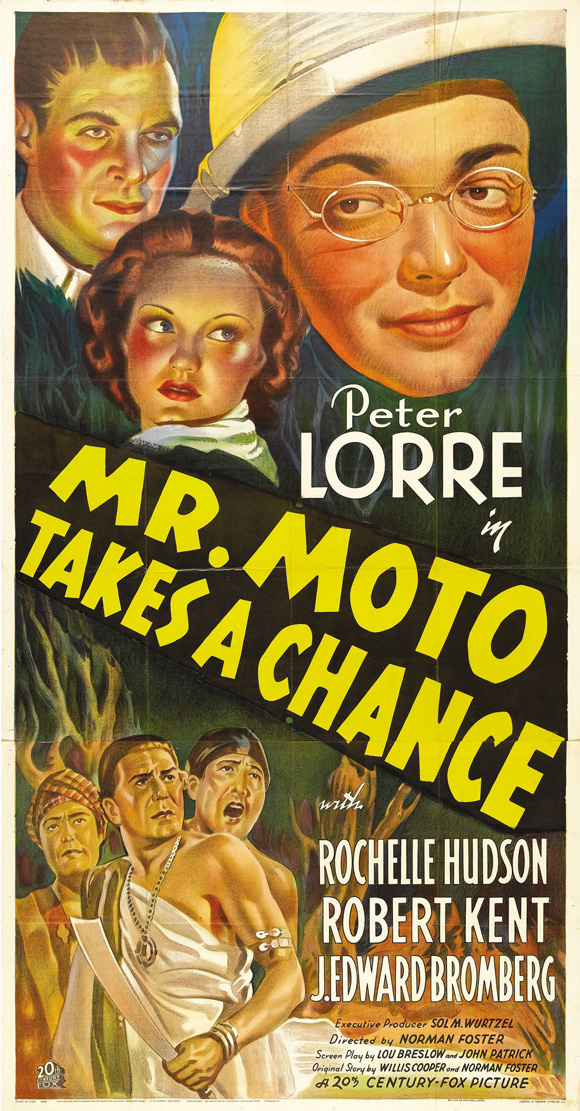
Mr. Moto Takes a Chance

Just when I thought I would be moving into less racist, more accepting/progressive roles, I go and watch this movie. Dear God.

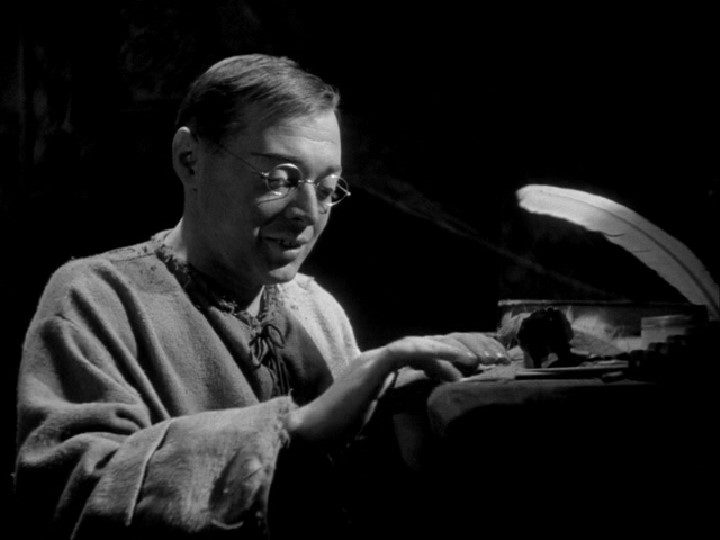
Mr. Moto Takes a Chance takes the Japanese secret agent to Angkor Wat in Cambodia, where he is spying on the king of the village/country/city of Tong Moi for unknown reasons. While he is there, an adventuress, Victoria Mason (Rochelle Hudson) "crashes" her plane after it "catches fire" (she set it with a flare) but survives and is taken to Tong Moi. Two reporters, Chick (Chick Chandler) and Marty (Robert Kent), are doing some wildlife filming when they spot Victoria's plane going down, so they rush on over to the crash site and do some filming. However, Victoria has already been taken to the King of Tong Moi (J. Edward Bromberg) by his magical adviser Bokor (George Regas) after meeting Mr. Moto (Peter Lorre), who is posing as an archaeologist. Marty and Chick catch up to Victoria, Bokor and the King of Tong Moi and want to film them. Unfortunately, the King's favorite wife drops dead from a poisoned arrow, but Bokor blames it on Marty and Chick's demon camera, and orders them to be taken away for a "trial by the gods." Bokor takes the two reporters to the Temple of Shiva where he burns them with hot metal and it hurts them (of course). This deems them guilty of their crime and they are about to be thrown in a big pit to die when an elderly guru interrupts them. The guru proves how magical and powerful he is when he doesn't get burned by the hot metal and he charms a snake, so he orders Bokor to let the reporters go. Bokor does so and he is mad. The next day, Moto approaches the reporters and tells them that he would pay a hefty price for pictures of the inside of the temple. Chick and Marty agree and go off towards the temple, but Victoria Mason follows them! However, when they arrive, Bokor and an unnamed servant try to kill them with poison darts too! They duck down and hide, and, lo and behold! The guru! He rescues them from Bokor and the servant but throws Chick and Marty's camera down the well. Bokor sees this, and contacts the guru after Chick, Marty and Victoria leave, and asks the guru if he can kill Moto. The guru agrees and returns back inside the temple. He digs around until he finds a secret trap door that leads to an underground room. In it, there are loads of ammunition. Then another unnamed servant climbs down into the underground room and tries to stab the guru, but the guru strangles the assassin with his own two bare hands! Then the guru runs away through a secret passageway, and reveals himself to be Mr. Moto in disguise! Mr. Moto then writes a secret note saying that Bokor is in charge of a rebellion against the King and that he (Moto) has found the secret stash of ammunition and sends it off via carrier pigeon. The carrier pigeon is then shot down by the King of Tong Moi, who sees the message and reads it. That night, the King hosts a big party with faux-Cambodian dancing and announces that he is going to marry Victoria Mason (airplane girl). He then serves roasted pigeon and gives the one that was a carrier to Mr. Moto, who finds a message on it and realizes the King found out his secret! Later that night, Moto is marking the ammunitions cellar on a map when Bokor and another unnamed servant attempt to stab him. But, in a display of badassery, Moto stabs the servant with his own knife, takes the servant's clothes and runs away. Victoria Mason goes to visit Mr. Moto but finds the stabbed servant. She pokes around in the itty bitty house until she finds Mr. Moto's map hidden in a spear. Bokor spots her and throws a dagger at her, which misses her narrowly. She is then kidnapped by Bokor and taken away to the Temple of Siva for questioning! They are about to subject her to the hot metal torture until - huzzah! - the guru appears. He "hypnotizes" Victoria and whispers to her that he is Mr. Moto. Victoria follows along and is a good hypnotee, until Marty (who followed them to the temple) bursts in and attacks guru/Moto and "rescues" Victoria, although he ends up getting tortured too. Bokor commands his nameless servants to light bonfire signals so that this one Captain Zimmerman (Frederick Vogeding) can bring him his guns. Bokor wanted the guns so that he could overthrow the King and "[drive] every foreigner from Asia!" Then he has his unnamed servant shoot Captain Zimmerman and Victoria lets slip that the guru is really Mr. Moto. Then Mr. Moto busts out his karate chop hands and fights everyone. Bokor escapes and rounds up the rest of Zimmerman's men, while Moto, Victoria, Marty, and Chick (who tagged along) become friends and find guns in the temple. There is a big shootout between our Fab Four and Bokor and Zimmerman's dudes, and Chick gets shot in the arm. Then Victoria Mason reveals that she's not a plane girl - she's a spy! And Mr. Moto reveals that he isn't an anthropologist - he's a spy! They're both spies! Then the King arrives with his troops and goes after Bokor and Bokor's guys - but the King wants to take Bokor's ammunition and stage a revolt against the French! The King is revolting! He plans to kill Marty, Chick and Mr. Moto but Victoria distracts him and somehow the King ends up in the ammunition cellar, which Mr. Moto sets fire to. Everyone except the King escapes from the temple before it blows up. And then our Fab Four gets on a boat to go... somewhere else. The end!

"No devil in box, just a movie camera! Miss Mason, will you tell Dracula there that we're not gonna hurt anybody?"
You know how everyone talks about how racist the stereotype of Charlie Chan is? Mr. Moto takes the cake. 
God, the yellowface. It's so awful. I had never seen any prosthetic teeth until I watched Breakfast at Tiffany's with my best friend Mr. Yunioshi. These are some serious prosthetic teeth. They don't stick out as much as some caricatures that I have seen, but these are pretty bad. They're large and black around the edges. They're just silly, and painful to look out. And some pretty serious taping of the eyelids. If you look at Peter Lorre's real teeth, they're not much better. But would his teeth be forgiven because he's really Hungarian? Lorre also adopted a horrific accent for this too - lots of slurring of the speech and mixing up the "r"s and the "l"s - pretty standard "Oriental" accent, but it's worse than Charlie Chan's (lack of an) accent. He also says "Oh so?" all the time. All the time. Every time there is something of interest, it gets the "cute" little "Oh so?" and an inquisitive bow. Of course, you can't tell if Peter Lorre had his skin darkened in order to appear more "Japanese," but the bows at the waist, the buckteeth and the slanty eyes are enough! Shame! 

"What do you make of that gravedigger?" "If I was castin' a horror picture, I'd have him play the murderer."
The character of Mr. Moto was created in response to the death of Earl Derr Biggers, author of the Charlie Chan novels. Once there were no more fresh Charlie Chan novels, readers needed another Asian sneaky guy to satisfy their Oriental mystery fetishes. Enter Mr. Moto. 
Mr. Moto is sly and sneaky and smiley. He knows martial arts (judo, jiu-jitsu). He is more than adept at disguise. He speaks 4 languages. He works alone. If Jackie Chan is the son of Charlie Chan, then Bruce Lee is the son of Mr. Moto, and Moto is the brother of Mr. Yunioshi. It's a whole family of stereotypes! But I digress. Mr. Moto is (possibly) an even more damaging and offensive caricature than Charlie Chan. He's not as subservient as Charlie Chan is - he's more sly and shifty and doesn't seem to be trusted by anyone, whereas Charlie Chan is everyone's favorite roly-poly, subservient detective. There's also the fact that Mr. Moto is a secret agent - it's his job to deceive people. Coupled with the fact that during this time, the Japanese were the "bad Asians," this makes a caricature of Japanese men (showing them as manipulative and untrustworthy). It's really disgusting. 

"Them Nipponese sure are peculiar birds."
In contrast, I've seen a lot of accounts that state that Mr. Moto is not a racist portrayal after all. They state that his politeness, combined with his cleverness, presents a sort of heroic character. It's insinuated that Mr. Moto is a sympathetic character, regardless of his shiftiness in the beginning of the story and how you don't learn he's a good guy until the very last 10 minutes of the film. They also state that while casting Warner Oland as Charlie Chan and Luise Rainer as O-Lan in the Good Earth was racist, casting Peter Lorre (a white guy) as Mr. Moto was not racist. Uh, what? Mr. Moto is just as humble and polite as Charlie Chan - why does the casting make any difference at all? Was it because Peter Lorre regularly played evil characters, and the role that turned him into a star was a (slightly) more sympathetic role? 

"Everything is possible here in the Orient."
What's really interesting is that this movie takes place in Cambodia. Cambodia? Really? What happened to things happening in Shanghai, or Canton, or Beijing, or something? Cambodia? This seems to be very odd... It seems to be the beginning of this division between East Asians (Japanese, Chinese, Koreans) and Southeast Asians (Cambodians, Vietnamese, etc.) and it's not... all... that great. Everything in this movie is fetishizing Cambodians and making them into mysterious, bloodthirsty savages! Evil Cambodians took away the reporters! Evil Cambodians burned the white reporters with a hot metal rod! They threatened to throw the white reporters into a deep dark well! One white reporter fell into  a mysterious tiger pit! Evil Cambodians assassinated the King's favorite wife with a dart-gun-thing! Mysterious Cambodian dancers who are really white danced around as entertainment to the white male guests! Victoria Mason was going to have to marry the Cambodian King of Tong Moi! Mysterious killing Cambodians! They tore off her shirt threatened to burn Victoria Mason with more hot metal! Oh no! It's all... so... bad!
"There's something about those ruins that Mr. Moto wants to find out, and it isn't archaeology!"
There are very few Asian extras in this film. Most of them portray servants and peasants, whereas the harem women are all white as white can be. I don't think there's a single sympathetic speaking role for any actual Asian actor in this film. It's become so expected that it isn't bothersome anymore - it just is. The fact that there are lots of unnamed Asian extras seems to justify the whiteface - but it really doesn't. It's all disappointing.

Saturday, January 22, 2011

A Jackie Chan Atrocity: The Spy Next Door

Who likes Jackie Chan movies? Not me!

This guy started his career as a Bruce Lee imitation - oddly enough, he was an extra in Enter the Dragon. Jackie Chan's movie characters end up being a strange smorgasbord of Charlie Chan's subservience and humbleness, Long Duk Dong's embarrassing eagerness, Bruce Lee's superhuman and "inherently Asian" martial arts skills and the slapstick-y, ugly comedic timing of Hnup Wan and Fan Choy a la One of Our Dinosaurs is Missing with a hyped-up Perpetual Foreigner thing going on. In other words, it combines all of the really obnoxious traits of the above stereotypes into one atrocious character who appears almost every year in a new C-list movie with weak plots and weaker dialogue. Jackie Chan movies tend to consist of slapstick, martial arts, an atrocious accent, some connection "back in China" and (usually) an attractive white woman as Jackie's (son of Charlie?) love interest. It's a formula that has been well overworked and seems to be the only thing that Jackie Chan is capable of, and The Spy Next Door is no exception.

The trailer speaks for itself. Jackie Chan plays Bob Ho, a CIA (Chinese Intelligence Agency, good lord) operative who disguises his true identity under Clark Kent-esque glasses and sweater vests. He's in love with his neighbor Gillian (Amber Valletta) and wants to marry her but her three kids hate him. When Gillian's dad ends up in the hospital for unimportant reasons, Bob ends up watching the kids. But some evil Russians (what?) want to capture Bob so they try to do that, but that doesn't work. In the end, there's a big fight and Bob and Gillian get married.

Look, Ma, no plot!
The plot itself is not important, because this movie was absolute crap. The acting is atrocious. There is no plot. There is only one decent punchline, and it's completely forgettable. You don't even need to watch the movie - the trailer will suffice. It's a Jackie Chan movie, for goodness' sake! It doesn't need a plot, because it has Jackie Chan and fight scenes and nameless, brooding baddies get their asses handed on a platter to them. 

In fact, the only moderately enjoyable scenes in any of Jackie Chan's movies (including this one) are the fight scenes, mostly because they don't usually require Mr. Chan to talk. He just fights and is done. This seemed to work for Bruce Lee too. They fought, and that was about the only tolerable thing onscreen that they could do. However, Bruce Lee's characters were  morally upright and super guys, whereas Jackie Chan's characters are all foolish and bumbling but ass-kicking as well. 

Dear God, it's called "Chop Suey?" Really? REALLY? "Chop SUEEEEYYY! Chop SUEEEEEEYY! Living here is very much like CHOP SUEY!" 
While it's great that Asians/-Americans have someone like Jackie Chan as a familiar/extremely famous face in the media, it's awful that he portrays the same characters over and over again, and that he really doesn't do anything other than beat up bad guys. It's all that he is really "good" for, and it's shameful. Has Jackie Chan been typecast as a slapstick-y foreign ass-kicker? Unabashedly, yes. He's made some attempts to get out of that stereotype, but unfortunately, he can't. It's too hard to imagine this "yellow Uncle Tom" as anything other than a slightly dumb, slightly FOB-y martial artist. That's it. All brawn, no brain. Maybe a tiny hint of a brain. But no emotional depth. A perpetual foreigner whose only purpose is to bust out some karate chop hands and take down a group of evildoers. Disappointment abounds.
In no way is this a slight on Jackie Chan himself. However, it's a slight on his characters and the roles he has played in movies past, and the persona that has been built up around him. 

Prepare for more Jackie Chan posts in the future.

Thursday, January 20, 2011

Charlie Chan in London

Charlie Chan isn't dead yet. Unfortunately. 

Charlie Chan in London takes Charlie to a large country house in London where he solves another fantastic, mind-boggling crime. In short: Condemned man was framed but his sister doesn't want him to die because she's convinced of his innocence. Condemned man's sister hires Charlie Chan to find that condemned man is innocent, which he is. Charlie Chan sets a trap and finds the real killer. But the plot isn't important. Charlie Chan is who's important here. 

Remember how I thought that watching Charlie Chan in an All-White Setting would be much more interesting? It really wasn't. If anything, Charlie Chan was even more humble,  subservient, annoying and extremely foreign. He was "Much honored to be of humble service to British lion" by inspecting the case of Condemned Man. His "humble eyes have had much practice" at making large deductions from tiny details (Sherlock Holmes ripoff, anyone?). When complimented on his deducting skills, he responds with "World is large. Me lowly Chinaman" with a simpering smile. He reminds the audience and his suspects that he's (most importantly) a foreigner - "Regret do not understand English, only American." and "Lowly Chinaman here!" and "[I am] Oriental, not British." and "Not very good detective. Just lucky old Chinaman." It's sickening. 

Because the character of Charlie Chan is played by a white man, shown belittling himself to everyone, and (essentially) a parody of all subservient Asian men, it is one of the more damaging stereotypes out there. I've said this before, haven't I? Along with Charlie Chan being a non-threatening (to other-than-Asian people) stereotype, it's also a very self-incriminating one. It shows that Asian men are ready and willing to demean themselves, but the fact that the character is portrayed by a white man (Warner Oland, no less) makes the entire thing a parody of the Asian man and someone (or something) not to be taken seriously. 

There is a character of a newspaper reporter in Charlie Chan in London that cannot seem to call Charlie Chan by his correct last name. He continues to call Charlie "Mr. Chang." It's always, "I see what you're driving at, Mr. Chang!" or "Mr. Chang enjoys his joke." And not once does anybody bother to correct him. Charlie Chan never bothers to correct him, the other unimportant people at the country house don't bother to tell Mr. Ignorant Reporter off either. What is this? Is this racism? Is this being anti-Asian, by refusing to say Charlie's last name right? Mr. Ignorant Reporter is a bit of a caricature himself, with his bushy handlebar mustache and his pseudo-British accent. Was messing up the Honorable Detective's name part of the caricature? Was it intended for comic relief or just... something random? I cannot decipher what purpose the messing up of the name was, or whether I'm just overanalyzing. I really cannot tell. 

Then there's the xenophobic, neurotic housemaid with an absurdly fake cockney accent. she's convinced that the Honorable Detective is a hypnotist (Fu Manchu anyone?) because he climbs through a window to talk to the Sister of Condemned Man. She's suspicious of the Honorable Detective because he's a foreigner ("There'll be death in this house until we get rid of that creeping, murdering foreign man!"). Homegirl is off her rocker. She represents all the people who remained suspicious of Asian people in general during this time period; however, I can't tell if her character is supposed to be there for comic relief or if she's just reminding the audience that no matter what, we can't trust the foreigner, even if it is our good ol' buddy Charlie Chan. 

Something that gets me every time I see a clip of Charlie Chan talking, I am struck by how little of an accent Warner Oland puts on. His speech is just slowed down with the funky syntax and grammar thrown in. There's no mixing of the r's and l's, no obvious, exaggeration or appropriation of an "Oriental" accent. I wonder if this was because Warner Oland never met an Asian person, so he didn't actually know how to do the inflections and whatnot? What it just lack of knowledge that kept the character of Charlie Chan from adopting a "real" Asian/Chinese accent throughout the productions.

Would Charlie Chan having a thick "Oriental" accent increase or decrease the amount of offensiveness in the stereotype? I honestly don't know. While I'm bothered that Warner Oland didn't do any research for the role in terms of the vocal performance, I'm also relieved that he didn't because it could have hurt the character's connotations so much more. The lack of research implies a slightly arrogant dismissal of the fact that some Asians do have accents, and it's a bit insulting. But I wonder if it would be twice as insulting if he did do research and try very hard to adopt a really thick, heavy "Oriental" accent. The fact that it would be a drunk Warner Oland (need I remind you that he's Swedish?) with a false and exaggerated accent, combined with the aphorisms and humbleness and subservience - the Charlie Chan stereotype would push a lot more buttons than it does already. An exaggerated accent would definitely add some weight to the whole "Perpetual Foreigner" thing - and not in a very good way (Captain Obvious reporting for duty). 

Some aphorisms before you leave:
-Front seldom tell truth. To know occupants of house, always look in backyard.
-Case like inside of radio - many connections, not all related. 
-When death enters window, no time for life to go by door.  

Wednesday, January 12, 2011

Amy Chua: The Tiger Monster

 Amy Chua's recent article in the Wall Street Journal has sparked much controversy and angry outbursts from the blogosphere, Asian-American and non-AAPA. Her snarky essay, entitled "Why Chinese Mothers Are Superior," was an explanation of "how Chinese parents raise such stereotypically successful kids." And here is how she did it. It's a shocker...
"Here are some things my daughters, Sophia and Louisa, were never allowed to do:
• attend a sleepover
• have a playdate
• be in a school play
• complain about not being in a school play
• watch TV or play computer games
• choose their own extracurricular activities
• get any grade less than an A
• not be the No. 1 student in every subject except gym and drama
• play any instrument other than the piano or violin
• not play the piano or violin."
I'm not sure what's worse, her treatment of her daughters, the fact that her daughters accept this sort of dictatorship, her snooty, higher-than-thou attitude, or the fact that she states that this method is exclusively for Chinese parents. This, in her twisted mind, is the right way, the "real Chinese way" to raise robots (whoops, I mean children). The "real" Chinese way? Amy Chua states that she "[knows] some mothers of Chinese heritage, almost always born in the West, who are not Chinese mothers, by choice or otherwise." Meaning that because my mom (and probably lots of other Chinese mommies) didn't raise me the same way Chua raised her offspring, my mom is not Chinese? Um...
Amy Chua is totally buying into the model minority stereotype by saying that "A lot of people... wonder what these [Chinese] parents do to produce so many math whizzes and music prodigies, what it's like inside the family, and whether they could do it too. Well, I can tell them, because I've done it." She embodies this stereotype and, most horrifyingly, is proud of it, stating that "the Chinese strategy (of parenting) produces a virtuous circle" whereas the "Western parents tend to give up" and that they "can only ask their kids to try their best." She praises the (in her mind) distinctly and only Chinese work ethic, saying that is where the "math whizzes and music prodigies" come from. At the same time, she belittles the Western parenting style as being not strict enough and too "concerned about their children's psyches." (Because everyone knows that the emotional stability of your child isn't worth crap next to academic excellency...) Chua turns the model minority on its head by essentially saying that Chinese kids aren't inherently gifted - it's the parents that push their children into being gifted and brilliant. It's the "Chinese way" of having high expectations that gets them so far in academics. Chua, making another grand, arrogant statement, proclaims, "If a Chinese child gets a B - which would never happen - there would first be a screaming, hair-tearing explosion. The devastated Chinese mother would then get dozens, maybe hundreds of practice tests and work through them with her child for as long as it takes to get the grade up to an A." So really, she, as the all-powerful "mother," should be praised for the successes of her children. Chua called her daughter, Luisa, self-indulgent when she was having trouble learning a musical piece - if anything, the way Chua screams for attention and praise for her parenting style is more self-indulgent than her daughter ever was. 
 

The title that Chua slapped on her parenting method (The Chinese Way) is also concerning. The damages from this newly named parenting style will be enormous and hard to get rid of. Chua's "Confucian filial piety" method on steroids is, so far, the only example of an ethnicity-based method that is at the forefront of everyone's consciousness. The fact that it is so tied to being Chua's interpretation of "Chinese" makes the horrific treatment of the children even worse. This is not an issue of raising children a newfangled way - it's the issue of raising them the (specifically) Chinese way. For people who have never met an Asian person (let alone someone of Chinese descent) or cannot even begin to fathom the existence of this type of dictatorship (sorry, parenting), this title becomes synonymous with Chinese people and therefore, Chinese parents. It may prompt people to think that "those Chinese parents are horrible people who have no love for their children" or something along those lines. It prompts me to think that Any Chua ought to be excommunicated from the Asian-American community. 
Those poor girls...
The dangers of an article like this one is that there are no other Asian American women with that level of fame who are mothers who could contradict her. Sure, there are other Asian American women out there in the media and whatnot, but they aren't mothers or they aren't recognized for being mothers. We're now left with only one representative of an Asian mother, and it's this Mom-zilla who is "happy to be the one hated (by her children)" and resorts to "[using] every weapon and tactic [she] could think of" in order to make her daughter learn one measly piano piece. Even more depressingly, this article was published in the Wall Street Journal, which, last time I checked, was a pretty widespread newspaper. Any rebuttals to her frankly horrifying methods of "raising" children are only showing up in blogs that may or may not have as big an audience as the Wall Street Journal. Therefore the damage that this article has done will be even harder to rectify, and all the work we've done to diminish the model minority stereotype is going down the drain and into the unfathomable bowels of hopelessness. 
This woman is a monstrosity. A smarmy, self-serving, arrogant "mother" with Machiavellian "ends-justify-the-means" and "extreme tough love bordering on abuse" parenting techniques. Ironically, she mentions "all these new books out there portraying Asian mothers as scheming, callous, overdriven people indifferent to their kids' true interests." Was that a shameless, self-indulgent plug for her own book, Battle Hymn for the Tiger Monster? Oops, I mean "Mother." 


Check the comments section below for further discussion!
An elegant rebuttal to Chua's techniques and the psychological damages to children that her methods will have.
More links all over the web - Especially this one.

Tuesday, January 11, 2011

Sherlock: The Blind Banker

Sherlock, a modern day adaptation of the awesome books by Sir Arthur Conan Doyle, is a fast-paced, funny series (with three episodes), produced and written by Mark Gatiss and Steven Moffat (writers for Doctor Who). It's a BBC program that debuted on PBS' Masterpiece Mystery in October and many wonderful blurbs have been written about it. I really really enjoy this show (understatement - I'm ever so slightly addicted to it) except for this episode, entitled The Blind Banker. 

Adapted from the original stories of The Valley of Fear and The Adventure of the Dancing Men, this story involves a Chinese smuggling gang, a China Doll/Lotus Blossom, a Dragon Lady, an ancient form of Chinese writing, Chinese acrobatics and a tea ceremony. Oh yeah, and two white people get murdered. 
Is it any wonder that I was more than slightly offended while watching this?
My Complaints:
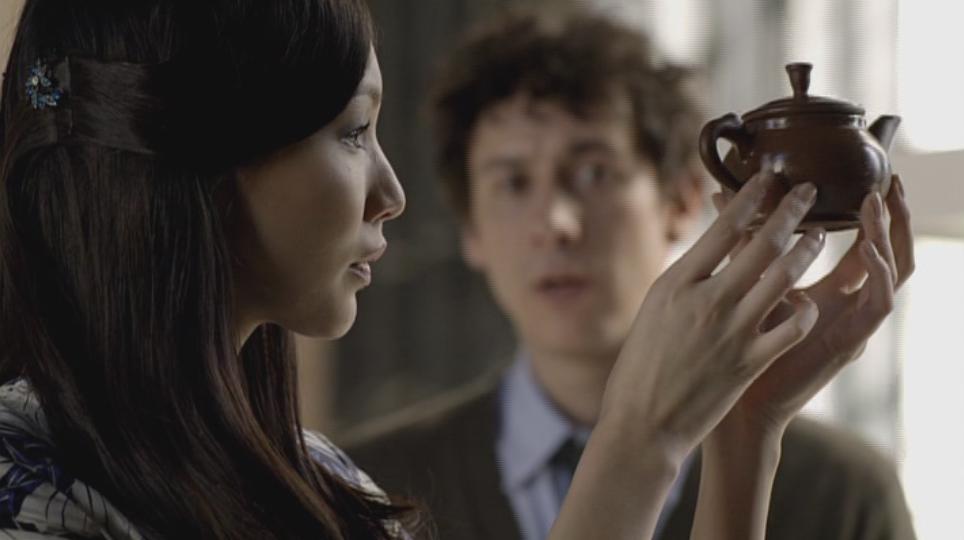
1. Soo Lin Yao (played by Gemma Chan) - The China Doll. She's pretty and innocent-looking, all wide-eyed and silky black hair and a non-whore-y, British Suzie Wong. She works at some museum in London where she performs a tea ceremony for tourists, spewing silly aphorisms about tea and shiny teapots. She escaped from China after being orphaned and joining a gang (called The Black Lotus - cringe) and smuggling drugs. Off she goes to London to a new life where she can do cute little tea ceremonies and have dorky little English boys try to ask her out. But alas! She is not safe! The Black Lotus catches up to her and BANG! She's shot dead by her own brother. Soo Lin Yao is pathetic and lacking in a backbone. 
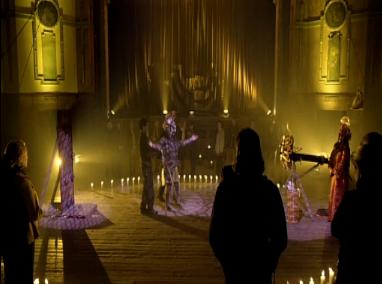
2. The Black Lotus Gang - Also referred to as a tong*. The gang, posing as a Chinese circus troupe, threatens their victims by spray painting yellow characters as part of a mysterious cipher onto a surface close to their victims. Then they track down their targets, kill them, and then plant a black origami (which is Japanese, people...) lotus somewhere on their body. The yellow paint is a clear indicator of the sickening racism embedded in the fetishized "Oriental" aspects of the story. Yellow? Can you get any more obvious? The origami lotuses are another indicator of ignorance and dismissiveness. Origami is Japanese. While there were forms of paper folding arts in other places in the world (even China), the art of origami remains a specifically Japanese art form. It is this sort of mixing of the two cultures without research that is increasingly annoying and offensive. The fetishization of the lotus flower doesn't help either. 
3. "The One They Call 'Shan!'" (not even listed in the Casting Credits - the indignity!) - The Dragon Lady. She controls The Black Lotus. She tortures John Watson. She wields a gun. She speaks with an awful, exaggerated accent, with her l's and her r's getting mixed up all over the place. She is ruthless. She dons a traditional-looking Chinese opera outfit and facilitates "death-defying acts from the Yangtze River!" She doesn't seduce anybody (Thank goodness) but she does watch Sherlock and John Watson do their mystery-solving from behind shady (pun intended) black glasses with an evil warlord-esque smirk on her face. She's the female Fu Manchu, with Sherlock playing the role of the great good white knight out to save the day and prevent "The One They Call 'Shan!'" 
4. The Villain of Indeterminate Race But is Obviously Not White - This character makes a brief appearance in the very beginning of the show as a samurai-sword-brandishing, turbaned, long-robed assassin enters 221B and attacks Sherlock! But, with Sherlock being the great white knight, this Assassin of Indeterminate Race is no match for our white-as-white-can-be hero (no slights on Benedict Cumberbatch intended), who easily defeats him with no weapons at all. For starters, the samurai sword being wielded by the man dressed in Berber-esque clothing? Mishmash of cultures, even a culture that deserves its very own independent study. Uncool, making that mishmash of cultures into the villain. And even worse, the bits of Sherlock versus Villain of Color and interspersed with John trying and failing to do the self-checkout line at the grocery store, so that the entire opening sequence really comes off as slapstick. All in all, it's a slapstick Unnamed Villain of Color versus White Knight Sherlock. Come on, we can do better than that, BBC!
5. The Dangerous Mystique of London's Chinatown - I don't think there was a single shot that was located in this setting that didn't scream, "This is a creepy, shadowy, mysterious place full of shady people who may or may not be assassins, and who knows? Maybe you'll find an opium den if you look hard enough!" Not only that, but Sherlock and John decide to go into the "Lucky Cat Emporium" to look for clues, where an old lady tells them, "You buy Rucky Cat? Onry ten pound! Your wife, she will rike!" In the "Lucky Cat Emporium," an old Chinese lady tries to sell a "Rucky Cat" to John, which he politely refuses. I am not joking. Do I even need to explain the incredibly blatant racism in that one little bit of a scene?
6. The Code! - There's a cipher code thing used to communicate with other members of the Black Lotus, and the code starts with a series of numbers that refer to page numbers in a certain book and then the first word on that page. The numbers are written in Suzhou (mistakenly called "Hangzhou" by Sherlock - tsk, tsk, writer of the script, do some research!), which then refer to the book "London A to Z." Again, more mysteriousness for shading dealings of drugs and other goods... Sneaky sneaky. 
7. The Music - The Sherlock theme and the usual background suspenseful music is stellar. But whenever Soo Lin Yao or The One They Call Shan showed up on screen, there was a sudden bout of Zen-like flute and some atmospheric zithers to accompany it (Thankfully, no obscenely loud gongs a la Long Duk Dong). I'm getting sick of zithers. And when Unnamed Indeterminate Race Villain of Color made his dastardly appearance there was - you guessed it - some funky funky sitar sounds. It was painful. 


It's really frightening that this slipped under the noses, maybe even was applauded, by the producers of the show. But is it because it was made in Britain? Is being Asian different over there? Would all the things I found offensive be considered offensive in the UK, or all over the world? Should I just start lowering my expectations for media that features either a token Asian or some sort of Asian-themed thing? Who knows?


Predictable and degrading stereotypes aside, the most frustrating this is that the original plot of The Dancing Men does not involve a Chinese gang at all, nor does The Valley of Fear. The Dancing Men has an American criminal chasing down an old flame and the Valley of Fear has no foreign criminal involvement at all. So why incorporate a Chinese crime ring involved in smuggling drugs and other goods around the world? That decision seemed to come completely out of left field with no real reason for it other than the fact that it would provide cheap entertainment and mystique to a story that would have been just as exciting as if it didn't have that "Oriental" vibe going on. 


I can only hope that next season doesn't feature stuff like this again. 
*The word "tong" has come to have unfortunate connotations because of its association with the term "tong war," referring to armed conflicts between rival Chinese groups seeking to control illegal activities such as gambling, opium smoking, and prostitution. "Tong" actually means "hall" or "parlor," in the sense of a society or association, and most Chinese tongs were men's fraternal or social organizations that existed to provide benevolent services to their members. (From http://www.uiweb.uidaho.edu/LS/AACC/SENSITIV.HTM)
A super great review of the Blind Banker, please read for more insight on the topics above!